
There is an inherent contradiction in designing a gold Daytona.
The Daytona began life as a purpose-built chronograph, and much of its visual identity still comes from that functional background: three registers, screw-down pushers, a tachymeter bezel, and a compact case designed around a mechanical stopwatch. Cover too much of that architecture in uninterrupted gold, however, and the watch can quickly move away from sporting tension toward pure ornament.
That is why the combination of a champagne-gold dial, yellow-gold case tone, black ceramic bezel, and Oysterflex-style strap works so well.
The black elements do not make the watch less luxurious. They control the gold.
In this Victory Factory interpretation of the 4130-generation 116518LN configuration, the more interesting question is therefore not simply whether the watch looks expensive. It is whether the dial, gold finishing, case proportions, strap integration, and Dandong 4130 movement behave like parts of the same watch.
That distinction matters. This is a Victory Factory Rolex replica, and its quality should be judged by the coherence of the entire build rather than by isolated specifications.
The Champagne Dial Has to Work With Light, Not Against It
A champagne-gold dial is more difficult to execute convincingly than it first appears.
Black and white dials are comparatively straightforward because their contrast remains relatively stable under changing light. Metallic gold is different. Too much reflectivity can flatten the dial completely, while an overly yellow or brassy tone can make the surface look artificial.
The goal is not maximum brightness.
It is controlled movement under light.
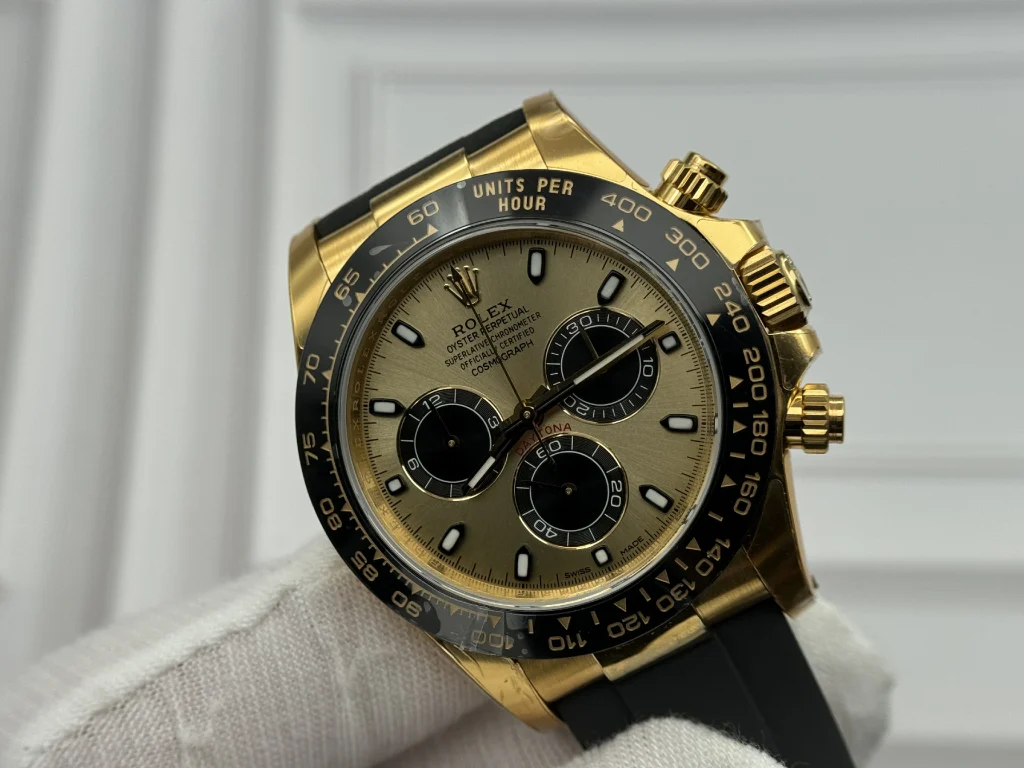
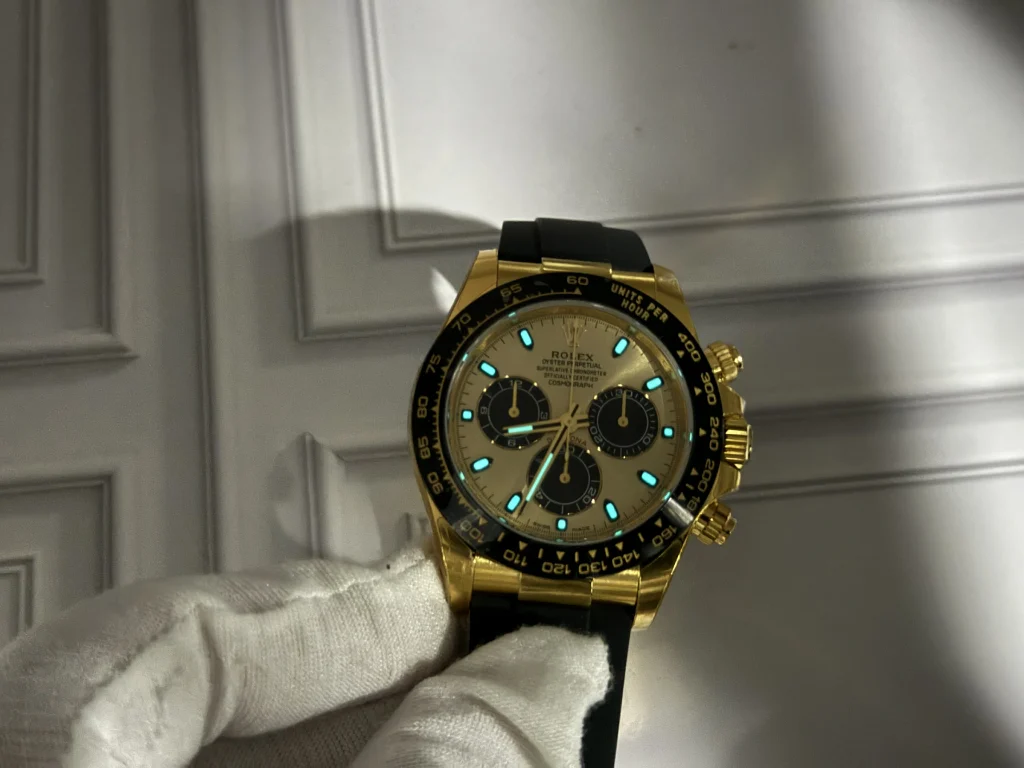
The dial on this Victory Factory Daytona uses a radial sunburst treatment that gives the surface different personalities depending on the viewing angle. Under stronger illumination, the gold opens into a lighter champagne tone. Under softer indoor light, it becomes deeper and warmer.
That variation is important because it prevents the dial from merging visually with the case.
The black chronograph registers then provide the second layer of separation. Instead of allowing the entire front of the watch to become one large warm metallic surface, the darker counters break up the composition and preserve the technical character of the Daytona.
This balance between gold and black is more important than pure color accuracy alone.
A successful champagne Daytona should still read immediately as a chronograph.
Gold Finishing Is Really a Test of Consistency
On a high-quality steel replica, a small difference between two surfaces may disappear unless examined closely.
Gold is much less forgiving.
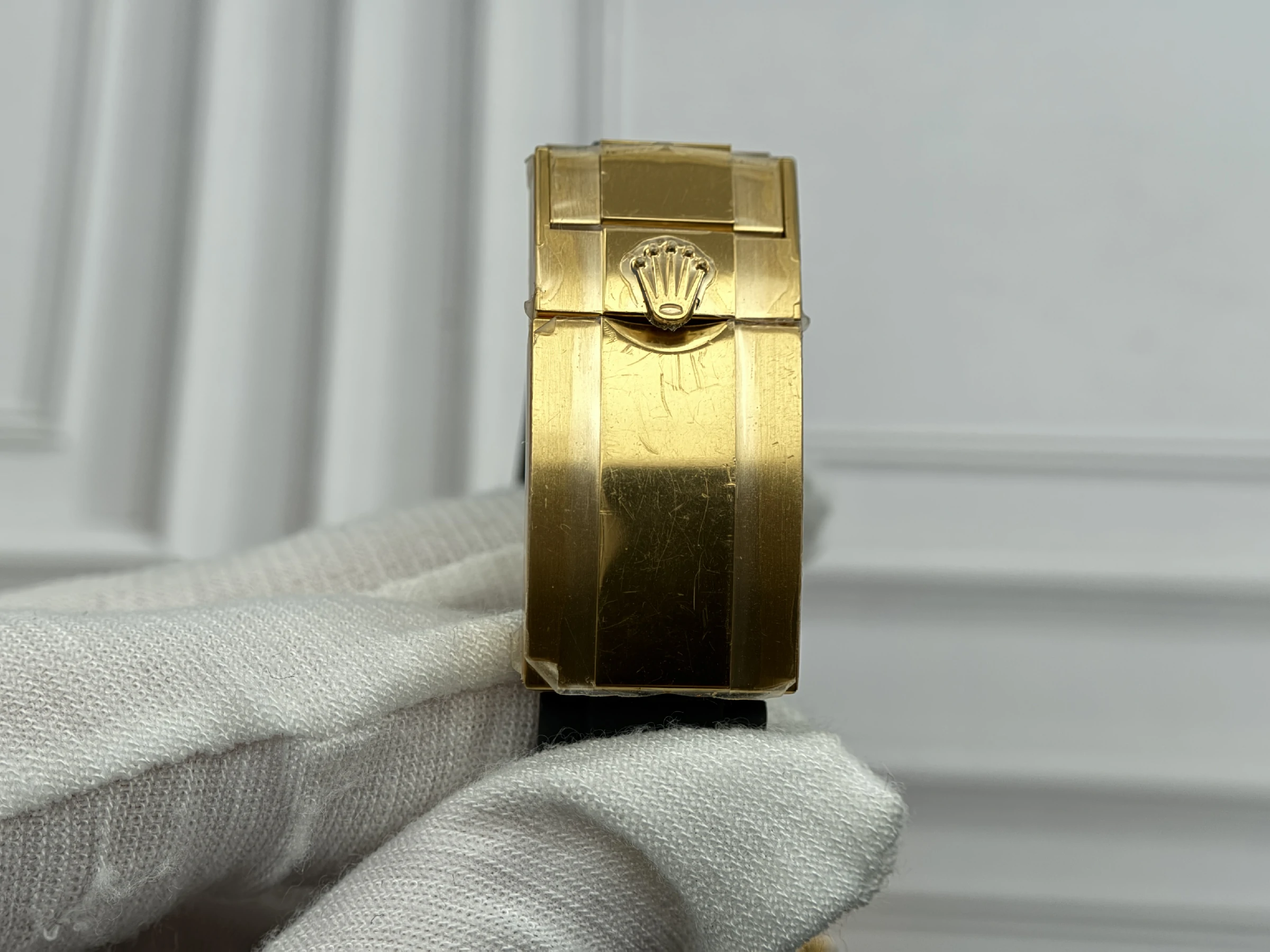
The human eye notices differences in warm metallic tones surprisingly quickly. A case that leans slightly orange next to a lighter crown or clasp can make the watch look assembled from unrelated components even if every individual part appears well finished on its own.
For that reason, one of the first things worth examining on the Victory Factory 116518LN is not the dial printing.
It is color consistency.
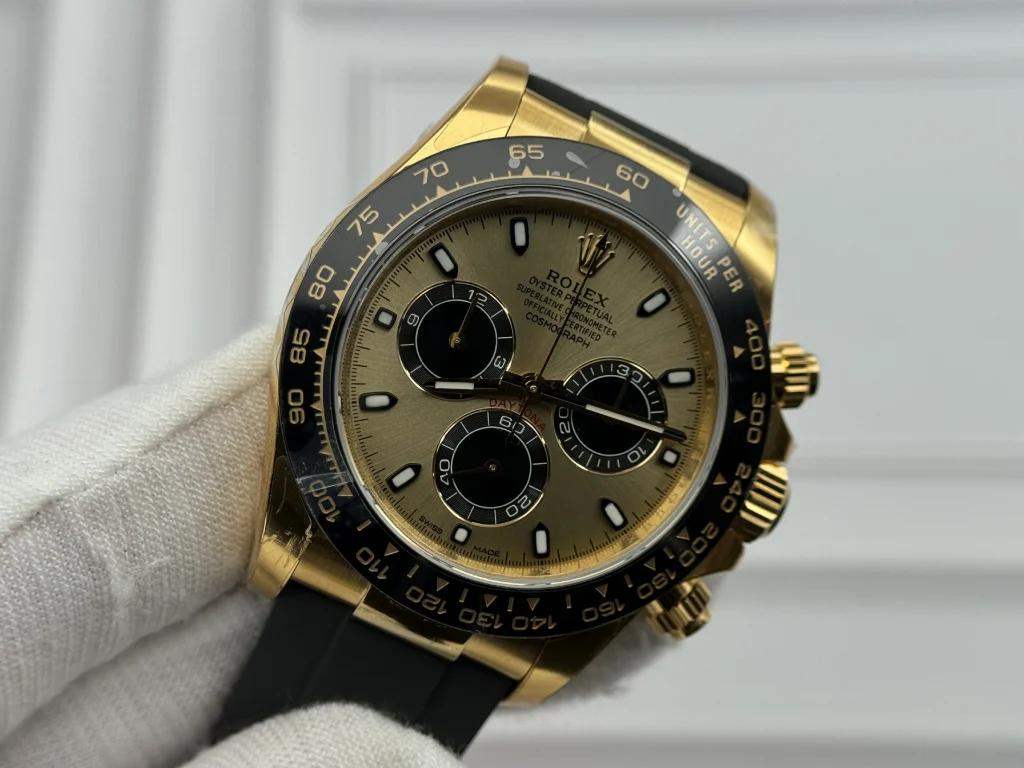
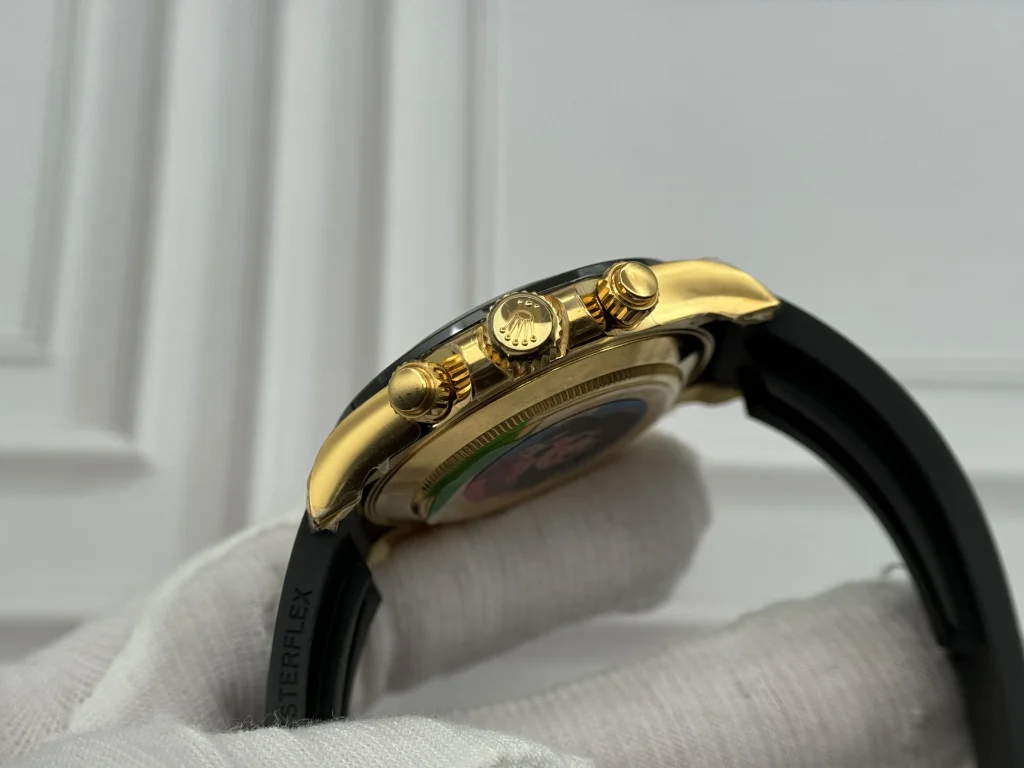
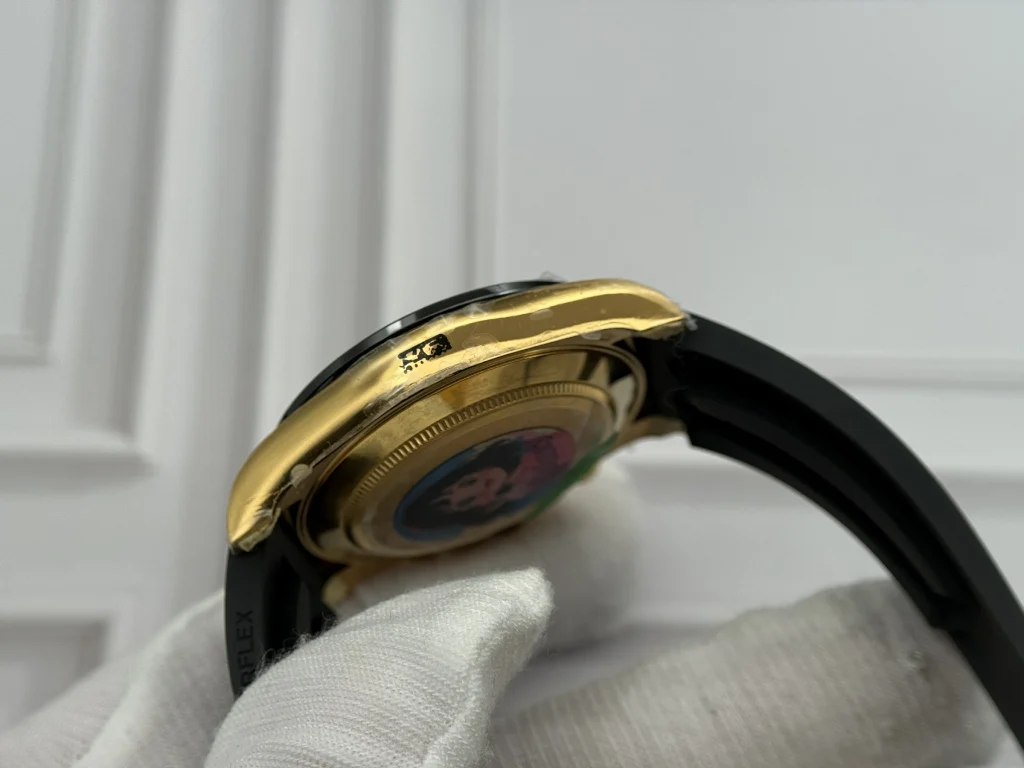
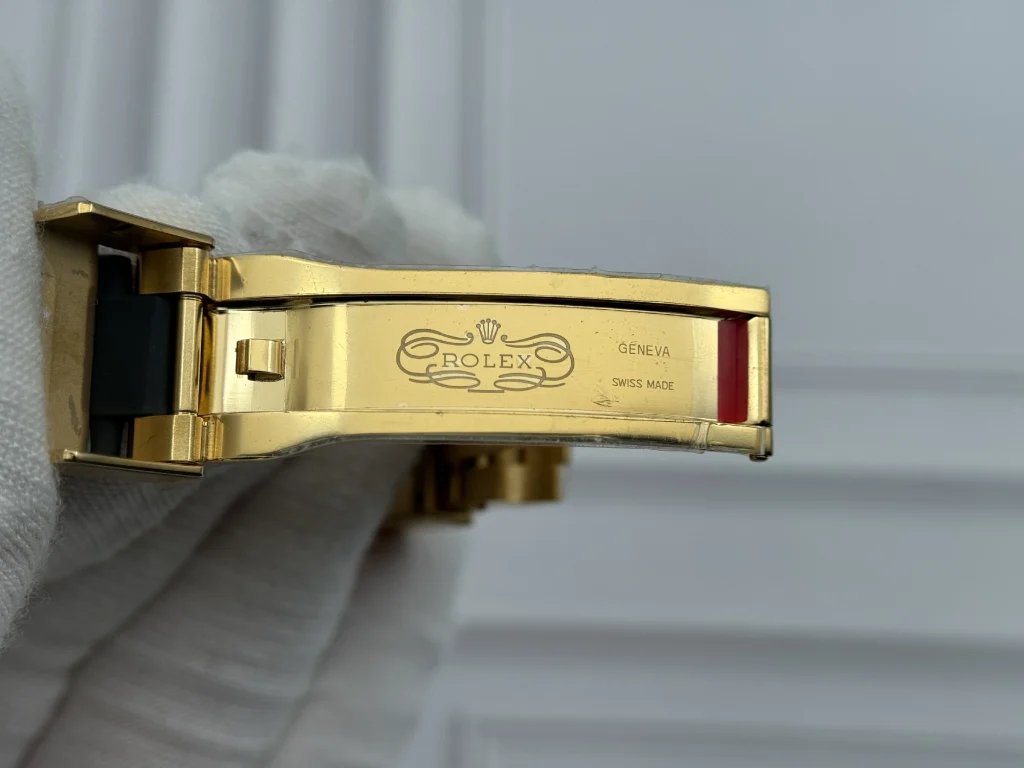
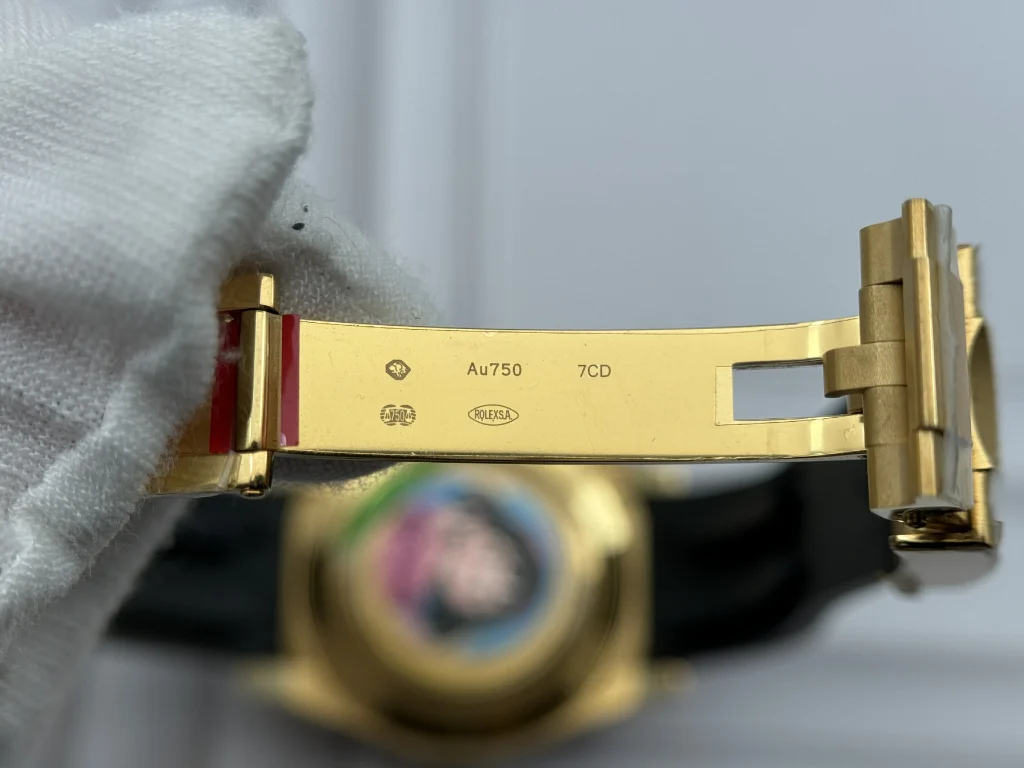
The case flanks, crown guards, screw-down pushers, crown, endlinks, and clasp should remain within the same yellow-gold family as lighting conditions change. The goal is not for every surface to reflect identically—polished and brushed areas naturally behave differently—but for none of the individual parts to shift obviously toward copper, red, or pale yellow.
Surface finishing matters just as much.
A Daytona case should not be polished into one continuous mirror. The architecture depends on controlled transitions between surfaces. The edges around the case, the area surrounding the pushers, and the relationship between polished and more subdued sections all contribute to the sense of structure.
This is where good gold finishing separates itself from simply applying a gold-colored surface.
Endlink Integration Is a Better QC Test Than Looking at the Logo
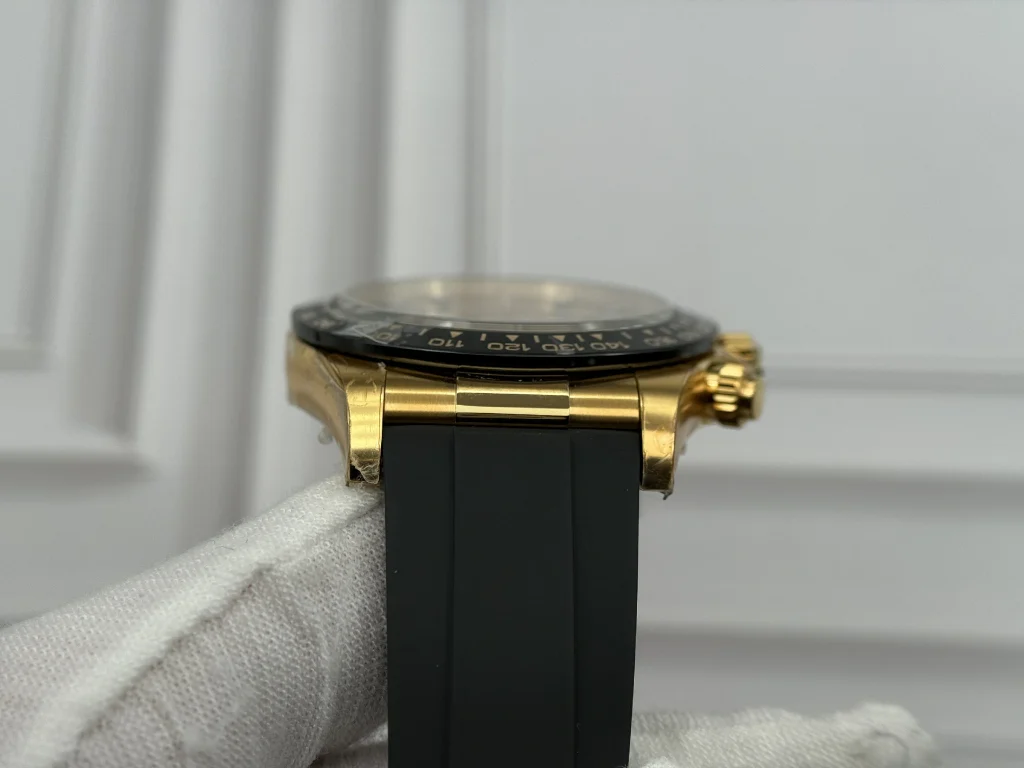
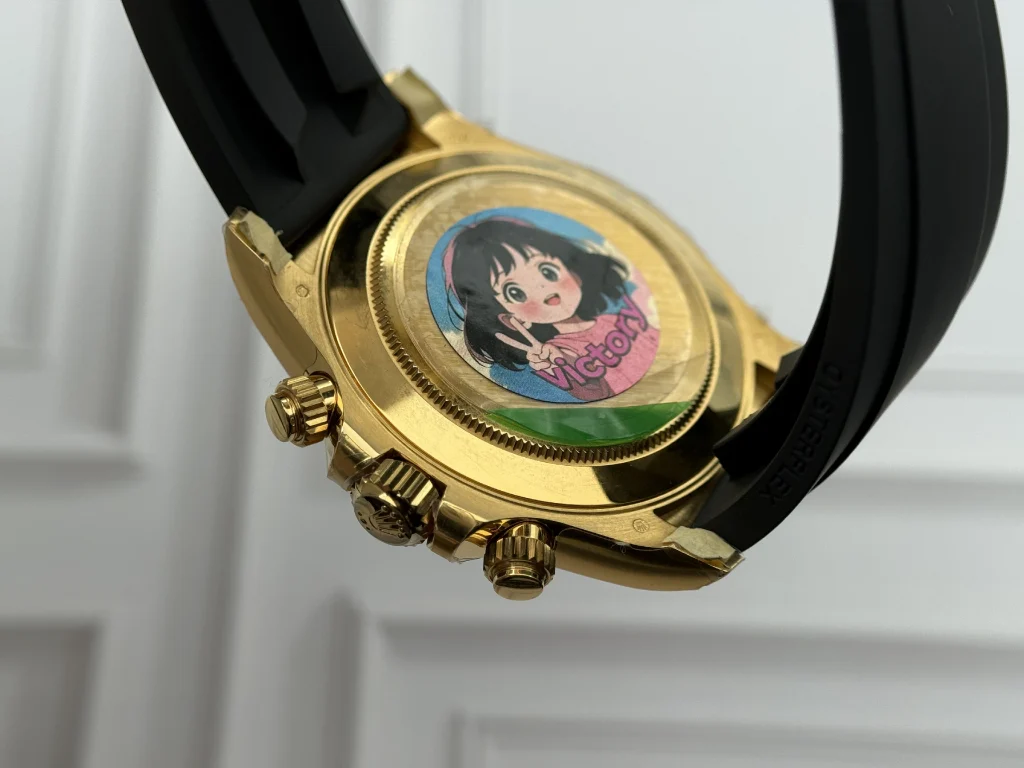
There is another area that deserves more attention than it usually receives: the transition between the Oysterflex-style strap and the case.
A metal-bracelet Daytona can hide small tolerances because the bracelet itself contains many moving components. A rubber-strap Daytona cannot. The junction is exposed and relatively simple, which means poor fit becomes immediately visible.
On a well-finished example, the metal endlink should sit tightly against the case and the strap should transition downward without an awkward step or oversized gap.
This is one of the areas I would check closely when inspecting an individual Victory Factory Daytona.
Look at the watch from the side rather than only from above. Check whether the two sides sit symmetrically. Press gently against the strap connection and look for excessive lateral movement. Then place the watch on the wrist and see whether both sides follow the wrist naturally.
These details tell you far more about assembly quality than enlarging the Rolex coronet twenty times on a screen.
Weight Matters Less Than Balance
Because this Victory Factory construction uses gold-finished 904L steel rather than a solid 18k-gold case, it should not be expected to reproduce the exact mass of a genuine solid-gold 116518LN.
That difference is unavoidable.
But the number on a scale is only part of the wearing experience.
What matters more is where the weight sits.
A chronograph case naturally carries more mass around the watch head. If the strap does not stabilize it properly, the watch can rotate away from the center of the wrist and feel top-heavy even when the overall weight is relatively modest.
The internal flexible metal-blade structure used in the Oysterflex-style strap helps here. When correctly sized, it gives the strap enough structure to support the watch head while still allowing it to conform to the wrist.
That creates a more planted wearing position.
For this reason, strap sizing is not a minor detail on this model. A good case can feel surprisingly awkward with the wrong Oysterflex length, while the correct fit can make the same watch feel much more compact.
The Ceramic Bezel Functions as a Visual Boundary
The fixed black ceramic tachymeter bezel is normally discussed in terms of its scale and Daytona identity.
On the gold version, it has another function.
It controls the color of the entire watch.
Without a dark outer boundary, the champagne dial and yellow-gold case would visually flow into one another. The black bezel draws a hard line around the dial and effectively contains the reflective gold surfaces inside a defined area.
That changes the perceived size of the watch as well.
Bright metallic surfaces tend to appear larger because they continually attract the eye. The black bezel visually compresses the center of the watch, while the black Oysterflex strap continues that darker framing beyond the case.
The physical diameter does not change.
The visual weight does.
This is one of the reasons the gold Daytona on Oysterflex can feel more controlled on the wrist than the same basic color language extended across a full gold bracelet.
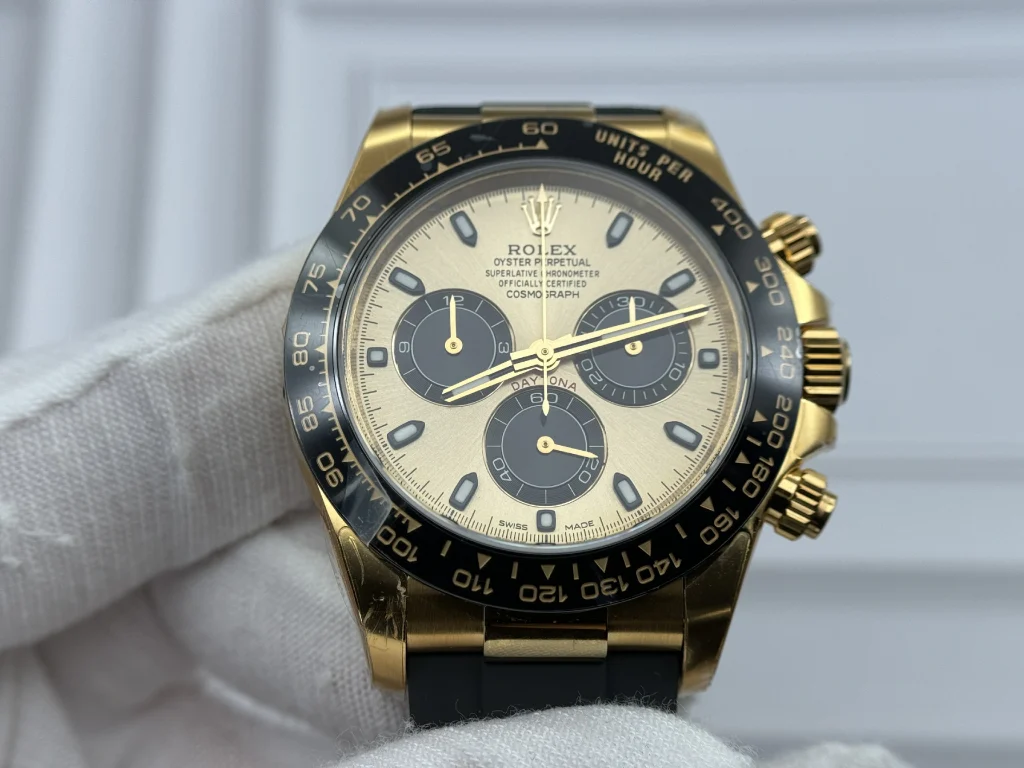
On the Victory Factory build, the bezel is also an important QC point. The ceramic surface should remain evenly dark, the tachymeter engravings should stay crisp, and the gold-tone filling should complement the case without becoming excessively bright.
Most importantly, the bezel alignment needs to be clean.
This is a fixed tachymeter bezel, not a rotating sports bezel, so there should be no discussion of rotational feel or bezel clicks.
The Dandong 4130 Is Where the Watch Becomes Mechanical
The exterior determines the first impression.
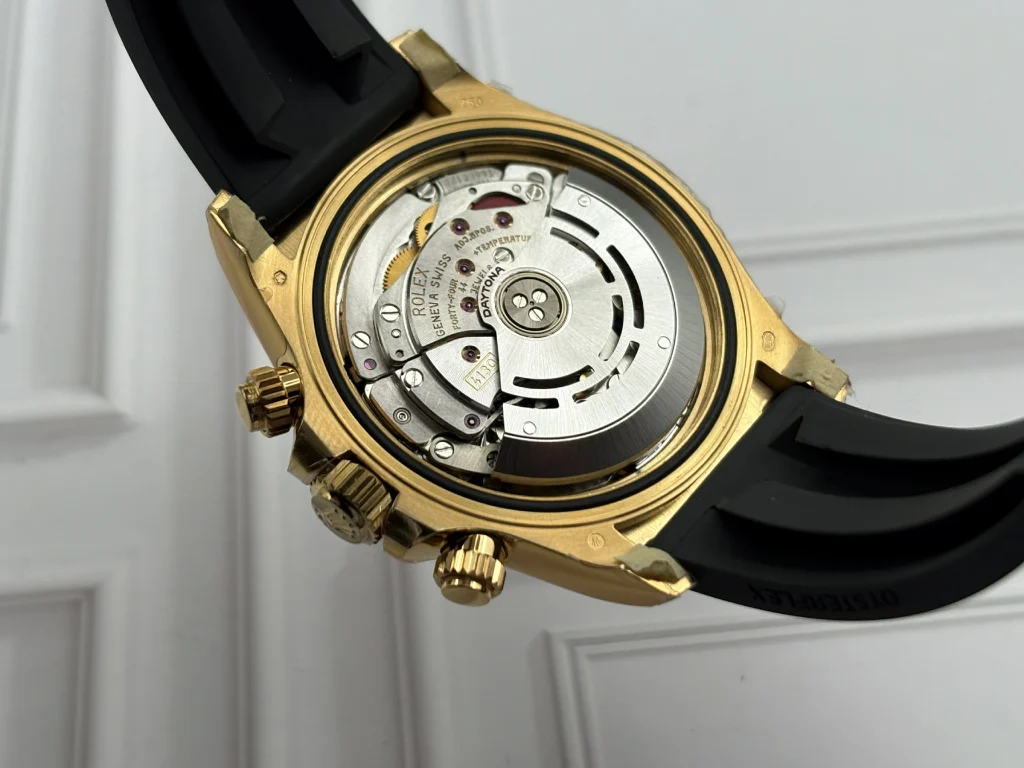
The Dandong 4130 determines whether the watch continues to feel convincing once the chronograph is actually used.
This Victory Factory Daytona uses a Dandong 4130 integrated clone chronograph movement. It is not a genuine Rolex calibre 4130, and there is still a difference in engineering refinement compared with the original movement.
Within the high-end replica Daytona market, however, the Dandong 4130 remains one of the more important integrated chronograph platforms.
Its advantage is not a decorative rotor or movement plate designed only to look correct through photographs.
It is the architecture itself.
The movement supports the correct chronograph layout while allowing the case to remain within the relatively slim proportions associated with the 4130-generation Daytona. That is an important difference from older modified chronograph solutions that often resulted in thicker cases or less convincing subdial geometry.
More importantly, the 4130 can be judged through actual interaction.
Unlock the screw-down pushers.
Start the chronograph.
Stop it.
Reset it.
A properly regulated example should give a deliberate, clean response through the pushers. The central chronograph seconds hand should begin without obvious hesitation and return cleanly toward 12 o’clock when reset.
Perfect alignment should never simply be assumed on every mechanical chronograph. It is something worth checking on the individual watch.
That makes chronograph reset one of the most useful QC tests on delivery.
Do Not Confuse Factory Power-Reserve Claims With Individual Results
Power reserve is another area where replica-watch specifications often become more precise than the evidence allows.
Victory Factory rates this Dandong 4130 configuration at roughly the 70-hour class when fully wound.
That is useful information, but it should be understood as a factory specification rather than a guaranteed result for every individual movement.
Actual autonomy depends on movement condition, winding state, regulation, lubrication, and how frequently the chronograph is operated.
For practical use, the better test is simple.
Fully wind the watch, note the time, leave the chronograph disengaged, and observe when the movement stops. If desired, repeat the same test with periodic chronograph use.
That tells you far more about the actual movement in your watch than repeating a theoretical number.
The Chronograph Is the Most Revealing Mechanical QC Point
A Daytona replica should not be judged only while all the hands are stationary.
The chronograph is part of the identity of the watch.
During inspection, the sequence matters.
The central chronograph seconds hand should start cleanly. The minute counter should advance consistently as elapsed time accumulates. When the system is stopped and reset, the hands should return close to their zero positions without obvious bouncing, sticking, or persistent offset.
None of these checks requires opening the case.
They are simple functional observations, but they reveal whether the movement and hand installation have been executed properly.
This is where the Dandong 4130 gives the Victory Factory build a meaningful advantage. The watch is not relying solely on a convincing exterior. It has an integrated chronograph architecture capable of supporting the functions that define a Daytona.
That is much more important than decorative movement markings.
Oysterflex Changes the Personality of the Gold Daytona
The black Oysterflex-style strap is often treated as a secondary specification.
It should not be.
Replace it with a full gold bracelet and the entire character of the watch changes.
A full bracelet continues the yellow-gold color around the wrist, producing a much heavier visual statement. Oysterflex interrupts that flow immediately.
From a distance, the strap reads first as black.
Then the eye moves to the ceramic bezel.
Only after that does the gold case and champagne dial become dominant.
The sequence matters.
Instead of announcing itself as a gold watch immediately, the Daytona reveals the gold inside a darker sporting framework.
That makes it easier to wear casually and prevents the watch from becoming visually exhausting over longer periods.
The strap also gives the 116518LN configuration a particular kind of dual identity.
It is luxurious without becoming formal.
It is sporty without looking utilitarian.
That tension is arguably the reason this configuration continues to work so well.
What I Would Inspect First on a Victory Factory 116518LN
If I were checking an individual example, I would not begin with microscopic dial text.
I would first look at the watch as a complete object.
Does the champagne dial separate clearly from the case?
Does the yellow-gold tone remain consistent across the case, pushers, crown, endlinks, and clasp?
Does the black ceramic bezel create a clean and even border?
Do both Oysterflex connections sit symmetrically?
Then I would move to the chronograph.
Check start, stop, and reset behavior. Look at hand alignment. Check whether the pushers feel consistent with one another.
Only after those fundamentals look right would I move toward the smaller typography, rehaut engraving, lume application, and other microscopic details.
This order of inspection matters because a watch with perfect lettering but poor color matching, bad strap integration, or inconsistent chronograph behavior is not a high-completion watch.
Final Thoughts
The Victory Factory Daytona 4130 Gold Dial on Oysterflex works because it does not depend on one spectacular feature.
Its success comes from several systems agreeing with one another.
The champagne dial provides warmth and changing depth under light. The black chronograph registers preserve readability. The ceramic bezel contains the gold visually. Oysterflex removes unnecessary visual mass and stabilizes the watch on the wrist. The Dandong 4130 integrated clone movement then gives the exterior a chronograph mechanism appropriate to the generation being reproduced.
None of these elements needs to shout.
They simply need to work together.
That is a much stronger definition of quality than saying a watch is “1:1” or “indistinguishable from genuine.”
For this particular Victory Factory Daytona, the real measure of completion is consistency: consistent color, consistent proportions, consistent assembly, and consistent mechanical behavior.
That is what separates a carefully executed gold Daytona from one that merely looks expensive in photographs.
FAQ
Is the Dandong 4130 the same as a genuine Rolex calibre 4130?
No. The Dandong 4130 is an integrated clone chronograph movement developed for high-end replica Daytona builds. Its architecture and functional layout make it one of the more credible options in the current replica market, but it should not be described as mechanically identical to a genuine Rolex calibre 4130.
What should be checked first on a gold Victory Factory Daytona?
Start with overall color consistency rather than microscopic lettering. Compare the case, crown, pushers, endlinks, and clasp under different lighting, then inspect the Oysterflex connection and test the chronograph start, stop, and reset functions. These areas reveal assembly quality very quickly.
Why does the Oysterflex version wear differently from a full-gold bracelet Daytona?
The black strap visually interrupts the gold and reduces the amount of reflective metal surrounding the wrist. It also helps stabilize the chronograph case when correctly sized, giving the watch a sportier and more restrained character than an equivalent full-metal configuration.