A Submariner has a ceramic bezel to draw the eye. A Daytona has a chronograph layout full of mechanical information. A GMT-Master can lean on the visual strength of its two-tone bezel.
The Day-Date has nowhere to hide.
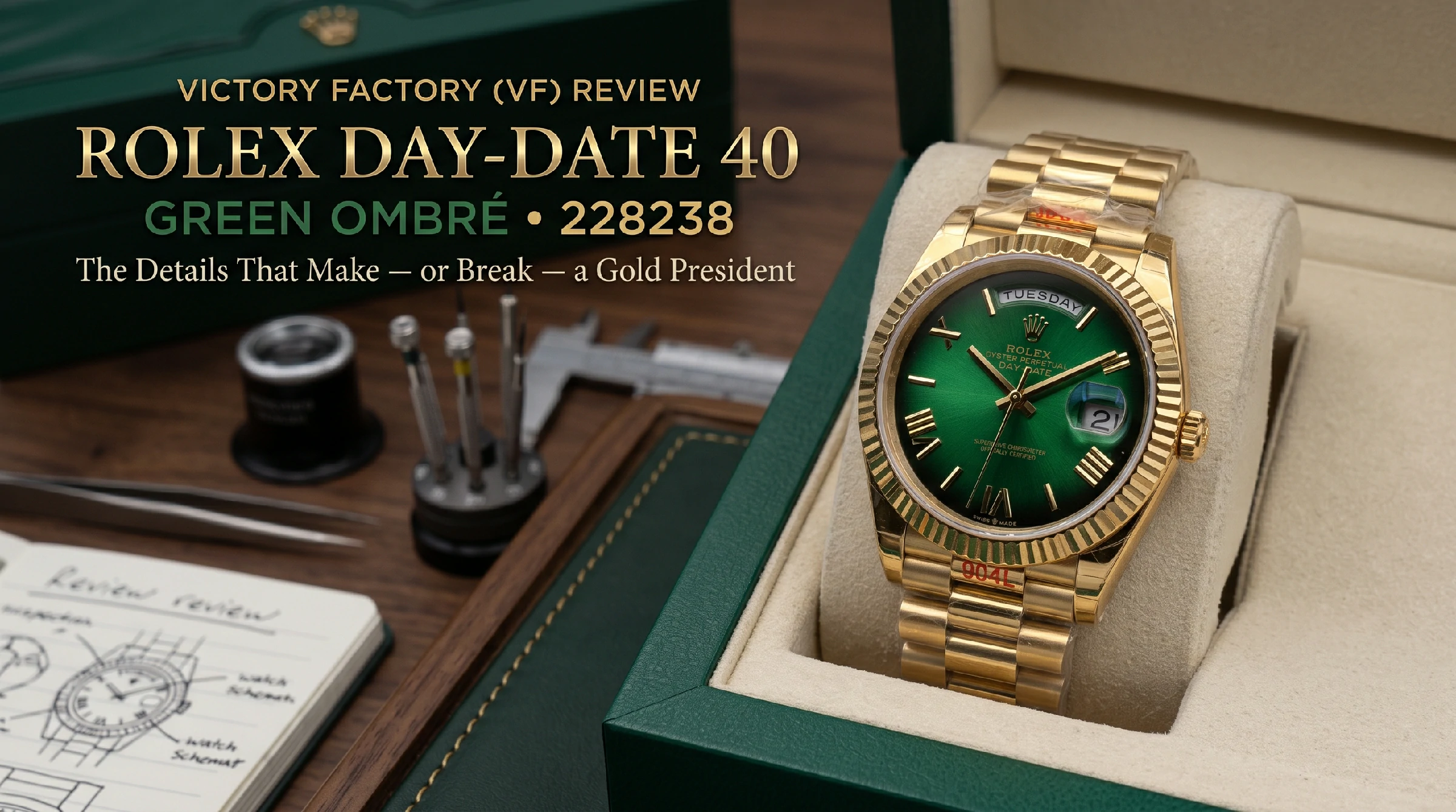
That is what makes the Victory Factory Day-Date 40 reference 228238 with Green Ombré dial more interesting than its specification sheet initially suggests. At first glance, the recipe is familiar: a 40mm yellow-gold-toned Oyster case, fluted bezel, President bracelet, green gradient dial, day and date displays, and a Dandong 3255 integrated clone movement.
But the Day-Date is one of those watches where individual specifications matter less than how perfectly everything agrees.
The gold has to remain consistent across the case, bezel and bracelet. The fluting must reflect light cleanly without becoming soft. The gradient dial has to move naturally from green to near-black. The day and date displays need to sit exactly where the eye expects them. Even the bracelet has to articulate with a very particular sense of weight and smoothness.
There is very little visual noise to distract from a mistake.
That makes the Victory Factory 228238 an unusually good test of overall factory execution.
The Green Ombré Dial Is Not Just a Color Choice
The first thing most people notice is the dial, but “green” does not really describe what makes this configuration difficult.
The challenge is the transition.
A conventional green dial can succeed if the color tone, printing and surface texture are convincing. An ombré dial adds another variable: the transition from the brighter central area toward the darker perimeter has to happen gradually enough that the eye does not perceive a printed ring or an artificial vignette.
That distinction matters.
If the center stays bright for too long and the edge suddenly turns black, the effect looks digitally produced. If the darker area begins too early, the dial can feel small and visually compressed.
A convincing Green Ombré dial should instead seem to change continuously.
From straight ahead, the center carries the strongest green presence. Move the watch slightly and the outer portion deepens, giving the hour markers and gold case a darker background. In softer lighting, the dial becomes considerably more restrained; under stronger illumination, the green center becomes much more apparent.
This dynamic character is what gives the configuration depth.
On the Victory Factory version, this is therefore one of the first areas I would examine closely. Not whether the dial is simply “the right green,” but whether the transition remains smooth at every position around the circumference.
An uneven gradient is surprisingly easy to spot once you know to look for it.
A Gold Day-Date Is Really a Color-Matching Exercise
The second major test has nothing to do with dial printing.
It is gold consistency.
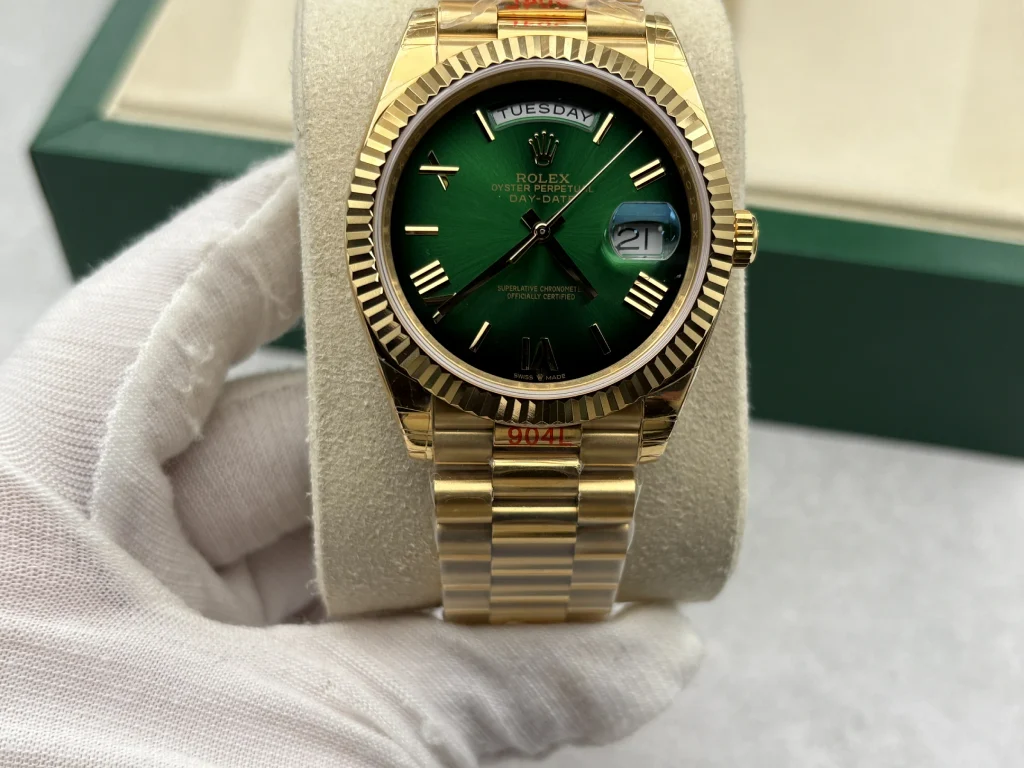
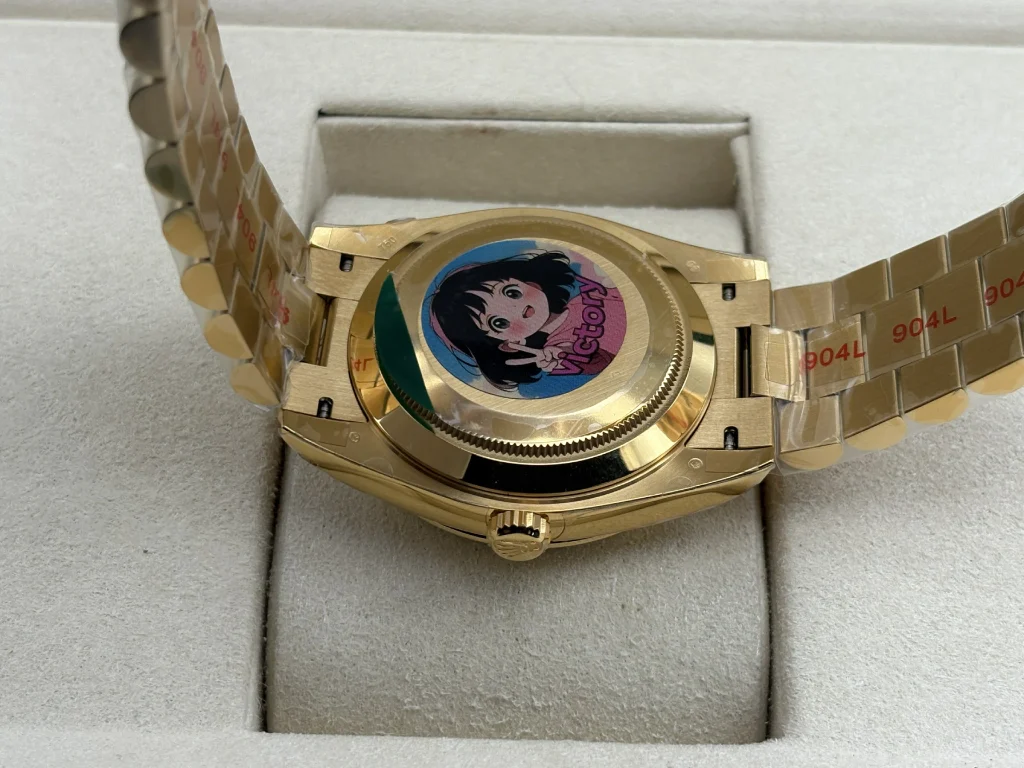
Victory Factory specifies this version as an 18K yellow-gold finish over a 904L steel construction rather than a solid-gold case and bracelet. That means it should not be confused with the material construction of the genuine 228238.
For a replica, however, the visual challenge remains the same: every gold-finished component has to belong to the same color family.
That includes more pieces than people initially think.
The middle case.
The fluted bezel.
The crown.
The bracelet center and outer links.
The concealed clasp components.
Even small differences become visible because the President bracelet places so much reflective metal directly next to the case.
This is why I would judge the watch under more than one lighting condition.
A finish can look convincing under warm indoor light yet become slightly coppery outdoors. Another may appear pale in neutral daylight but look excellent in photographs taken under yellow lighting.
The strongest execution is not necessarily the brightest or deepest gold.
It is the one that remains coherent.
And on a Day-Date, coherence matters more than spectacle.
The Fluted Bezel Is an Optical Component
It is easy to describe the fluted bezel as a decorative Rolex signature.
That misses half of what it actually does.
A properly executed fluted bezel is an optical surface.
Every ridge catches and releases light as the wrist moves. At certain angles, only a few flutes illuminate; at others, an entire side of the bezel seems to flash. That changing reflection creates the sharp visual boundary between the dial and the case.
This is especially important on the Green Ombré version.
You already have two visually strong elements competing for attention: the darkening green dial and the yellow-gold case. The bezel has to connect them without becoming a third disconnected element.
If the ridges are too rounded, the reflections become broad and soft.
If the geometry is too aggressive, the bezel can look mechanically cut rather than refined.
The best result lies somewhere between the two: crisp peaks, controlled valleys, and enough definition to produce narrow, clean flashes of light.
That is one place where photographs often do not tell the whole story.
A fluted bezel is best judged while the watch is moving.
The Day Window May Be More Important Than the Crown Logo
Collectors often focus heavily on tiny dial printing when checking a replica.
On a Day-Date, I would look at the calendar first.
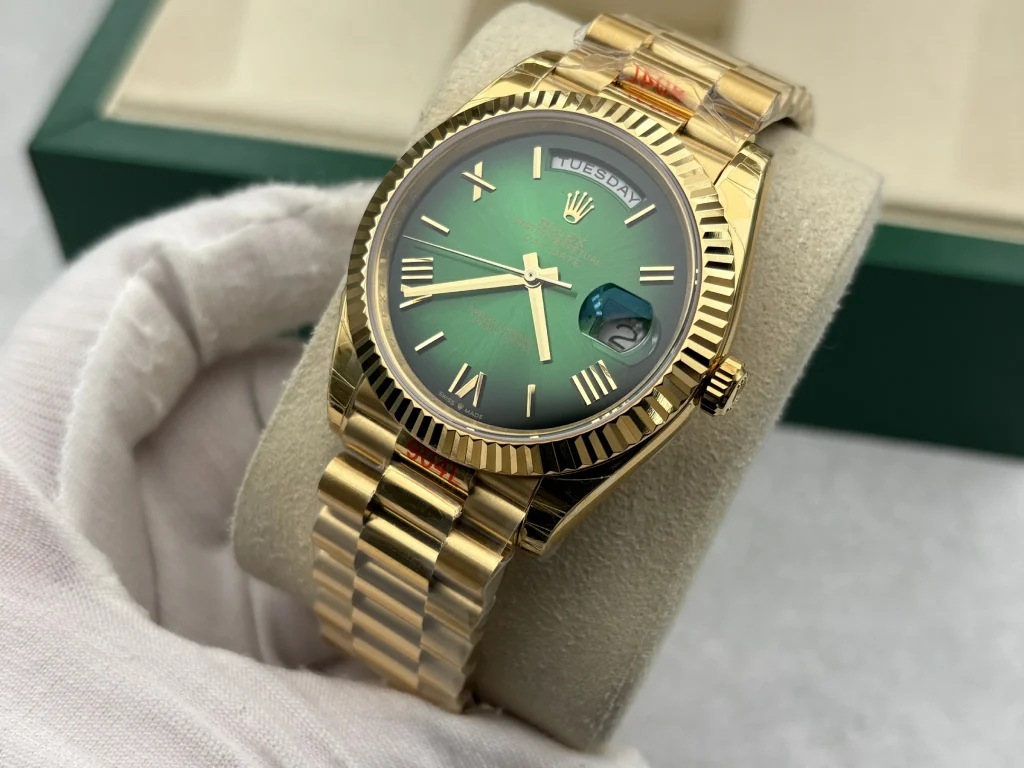
The reason is simple: the day aperture at 12 o’clock and the date window at 3 o’clock are among the largest printed elements on the entire dial. If either one is poorly centered, incorrectly scaled, or visually weak, you notice it long before microscopic differences in the coronet.
Start with the day.
The word should sit naturally within the curved aperture without appearing too high, too low or too close to one side. Different days contain different numbers of letters, so it is worth cycling through more than one day rather than judging only a single position.
Then check the date beneath the Cyclops.
The numeral should be centered inside the window and remain visually centered through the magnifier. A date disc can technically be aligned inside the aperture yet still appear slightly displaced if the Cyclops itself is not correctly positioned.
That makes this a system rather than a single detail:
date disc alignment + date aperture + Cyclops alignment + magnification.
All four have to cooperate.
This is one of the reasons the Day-Date can expose assembly quality so quickly.
Midnight Is the Most Interesting Time to Test the Dandong 3255
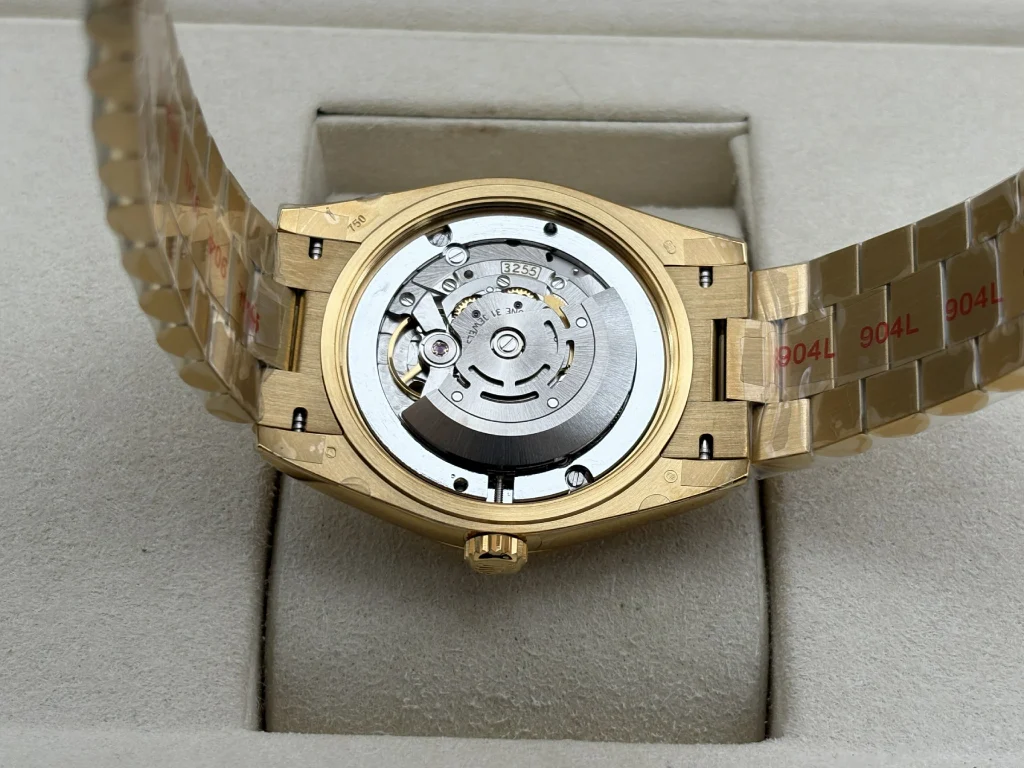
The Dandong 3255 is a much more relevant part of this watch than a movement photograph would suggest.
Victory Factory uses an integrated Dandong 3255 clone movement rather than a genuine Rolex calibre 3255. The two should not be treated as mechanically identical, and there remains a difference in refinement and long-term engineering compared with the genuine Rolex movement.
But the important part of a Day-Date movement is not simply how it looks.
It is what happens around midnight.
The day and date complications are the personality of the watch. When the movement approaches the changeover period, the calendar mechanism begins doing something that a simple three-hand movement never has to manage.
This gives owners several useful QC checks.
Does the date change reliably?
Does the day advance correctly?
Do both displays settle into their apertures cleanly?
After the change, are the day and date still properly centered?
Does rapid setting operate smoothly through the crown?
These observations tell you considerably more than decorative engraving on the movement.
A Day-Date with excellent exterior finishing but inconsistent calendar behavior would miss the point of the model entirely.
A Factory Accuracy Number Is Not a Test Result
Victory Factory lists an accuracy target for the Dandong 3255, but I would treat any such figure as a factory specification unless the individual watch has actually been measured.
The same applies to power reserve.
The product specification gives a broad range rather than an independent test result, and real performance can vary with the condition of the movement, winding state, regulation and usage.
Fortunately, both are easy to evaluate after delivery.
For accuracy, compare the watch against a reliable time reference over several days rather than drawing conclusions from a few hours.
For power reserve, fully wind the watch, note the starting time, and allow it to run normally until it stops.
These simple observations give you information about the actual movement in front of you.
That is much more useful than assuming every example performs identically because the product page lists a number.
The President Bracelet Determines Whether the Watch Feels Expensive
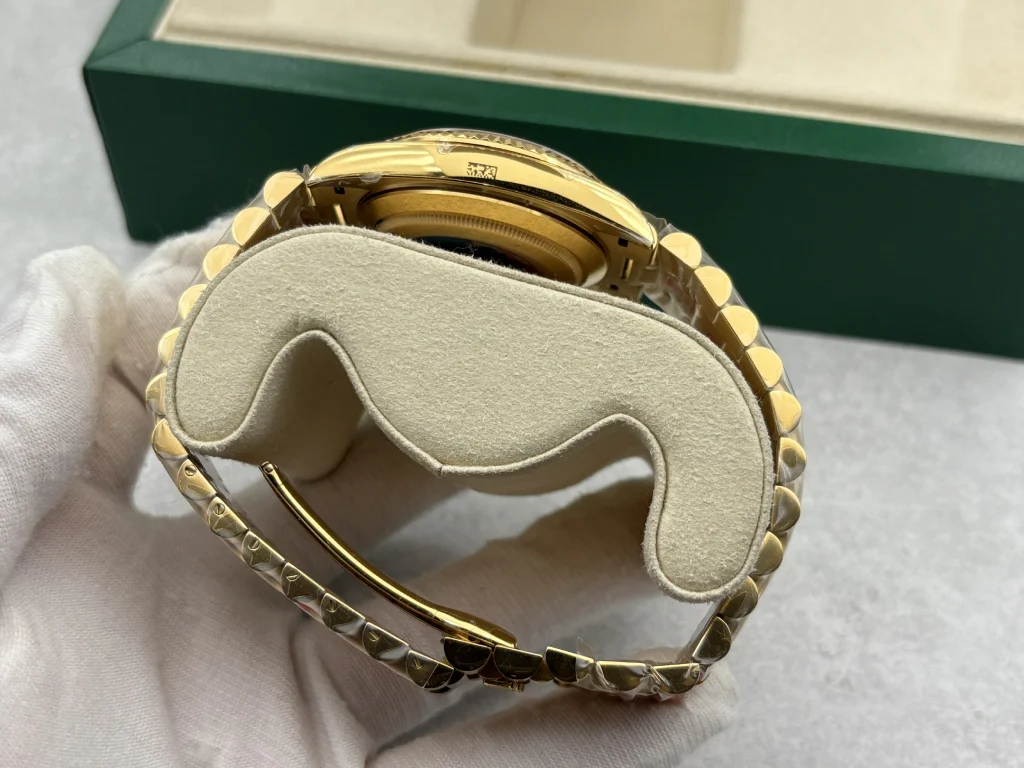
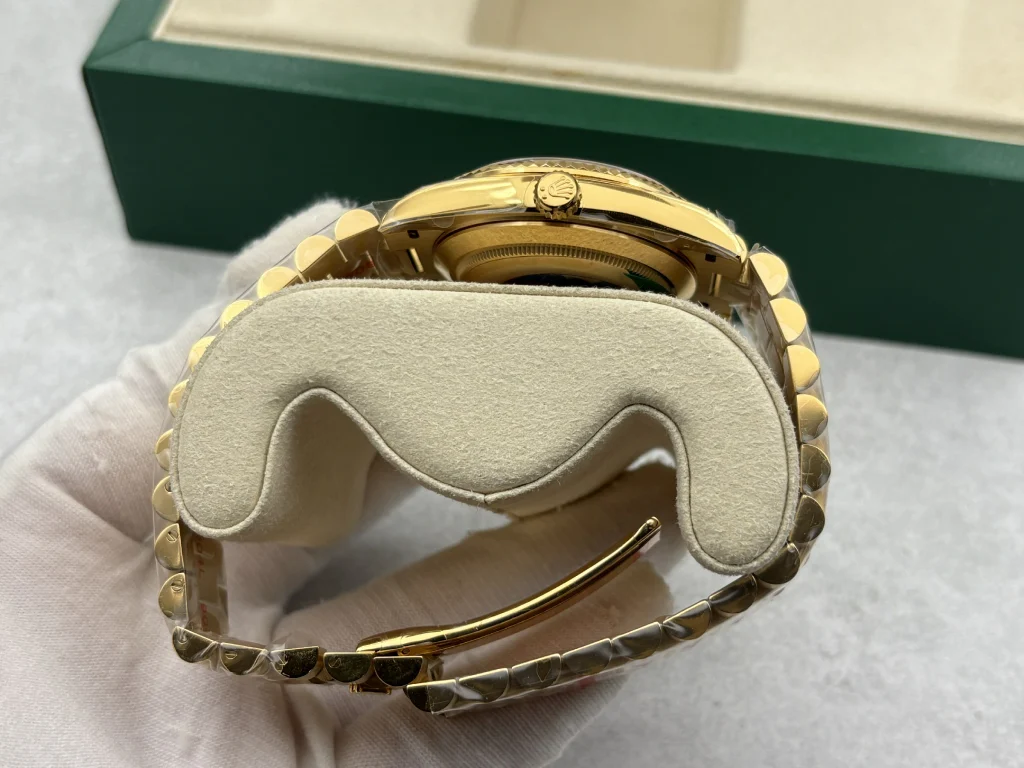
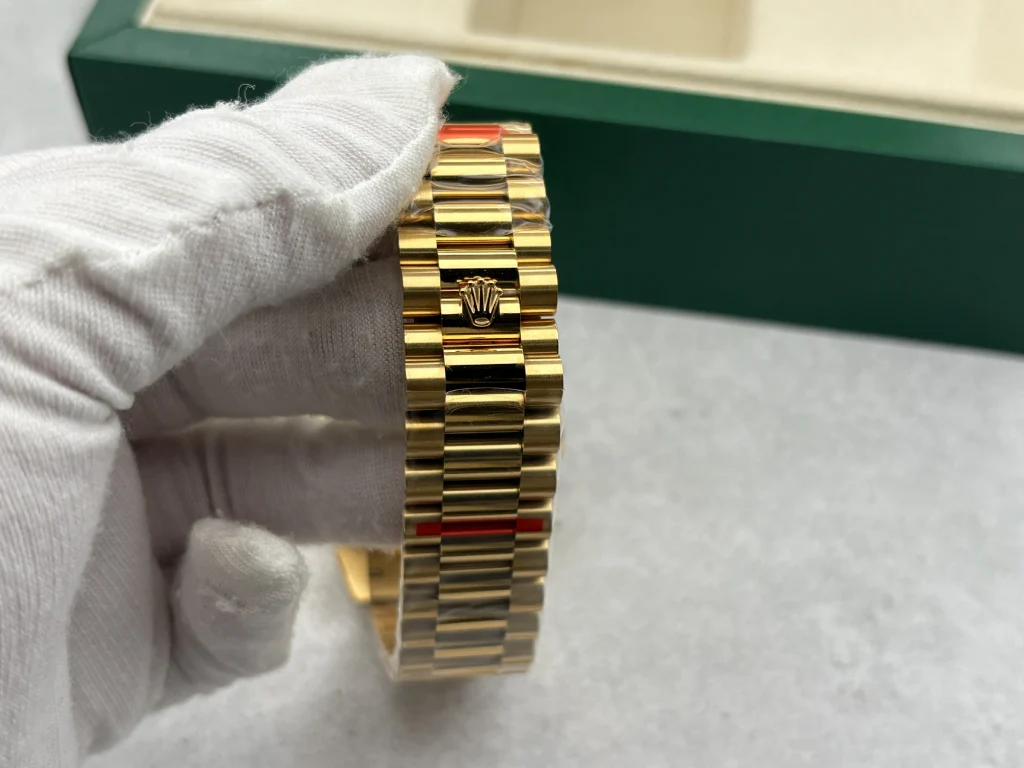
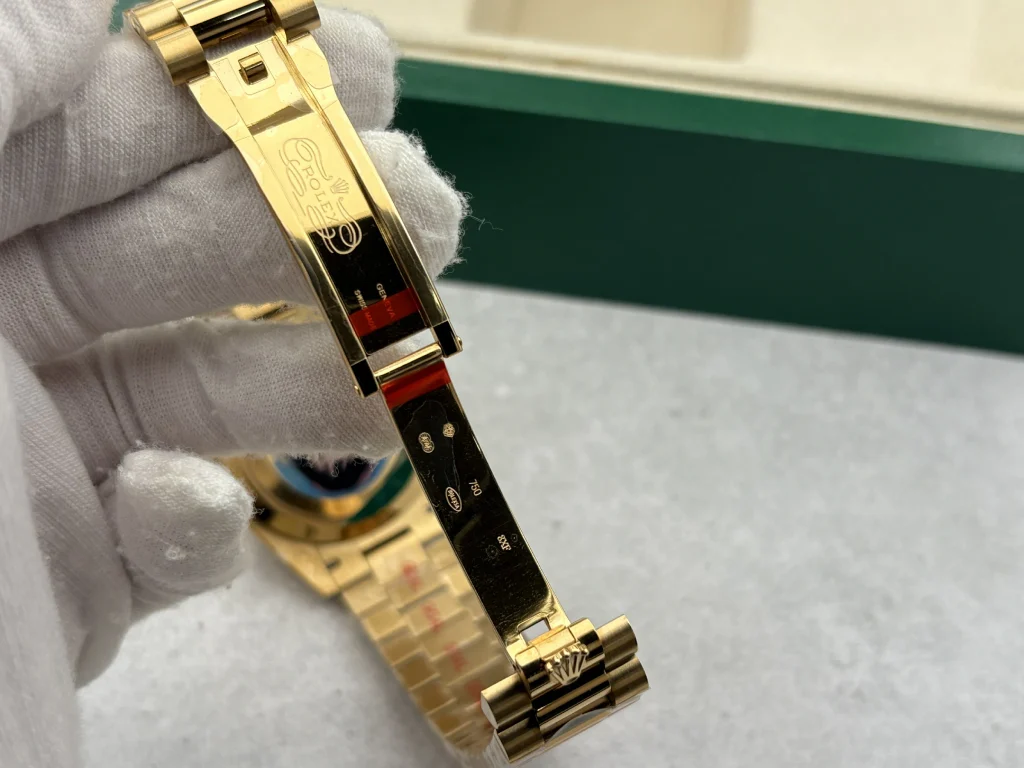
The President bracelet is not merely the bracelet attached to a Day-Date.
It is a major part of the watch’s identity.
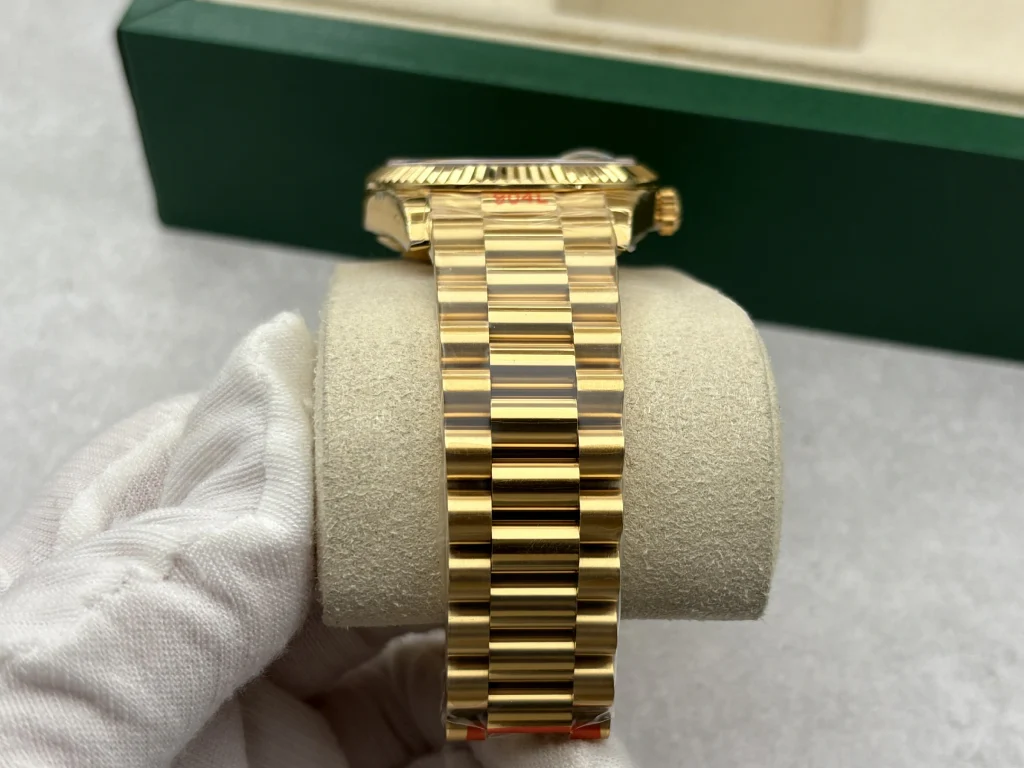
Its three-piece rounded links create a very different visual rhythm from an Oyster bracelet. There is more reflection, more articulation, and a softer transition around the wrist.
This creates a particular challenge for a replica.
Too much looseness and the bracelet feels insubstantial.
Too much stiffness and it loses the fluid quality associated with the design.
A better way to assess the Victory Factory bracelet is therefore not simply to shake it and listen for noise.
Look at how it falls.
Hold the watch horizontally and allow the bracelet to hang naturally. The links should articulate progressively rather than forming abrupt steps. When worn, the bracelet should curve around the wrist without isolated links appearing to resist the shape.
The concealed clasp matters too.
One of the defining visual characteristics of the President bracelet is continuity. A bulky conventional clasp would interrupt that. The folding mechanism has to disappear visually once closed, leaving the bracelet looking almost uninterrupted around the wrist.
This is another area where completion comes from details that are not immediately obvious in a front-facing photograph.
Weight Cannot Fully Reproduce Solid Gold—But Wear Still Matters
There is one fundamental difference that should be stated clearly.
A gold-finished 904L-steel Day-Date cannot reproduce the exact material density and wrist mass of a genuine solid 18K-gold 228238.
That is physics, not a QC issue.
Trying to disguise this difference with vague claims about “identical weight” does not make the review more credible.
The more useful question is whether the watch still feels balanced.
The Day-Date distributes a large amount of visual and physical presence through the bracelet, not only the watch head. If the bracelet construction is substantial and the articulation is good, the watch can still feel cohesive on the wrist even though its absolute mass differs from the genuine solid-gold version.
The distinction is worth keeping clear:
material equivalence is impossible here; proportional and visual execution can still be evaluated seriously.
That is a far more realistic way to judge a high-end replica.
The Green Dial Changes the Personality of Yellow Gold
There is another reason this particular 228238 is more interesting than a conventional champagne-dial Day-Date.
Green changes yellow gold.
A gold dial on a gold watch reinforces warmth everywhere. The result is extremely traditional and immediately recognizable.
The Green Ombré configuration introduces tension.
The center of the dial feels rich and saturated, while the dark perimeter makes the fluted bezel appear brighter by comparison. The yellow-gold hands and markers also stand out more clearly against the green background than they would against a matching champagne surface.
That contrast gives the watch a slightly more contemporary character without changing the underlying Day-Date architecture.
It is still unmistakably a President.
But it does not feel locked into the traditional image of a yellow-gold dress watch.
That is probably the strongest reason this particular dial has so much presence.
What I Would Check Before Looking at Microscopic Details
For an individual Victory Factory 228238, my inspection order would be very different from the usual “zoom into the Rolex logo” routine.
First, look at the dial from several angles.
Is the Green Ombré transition even all the way around?
Does one side darken sooner than the other?
Then compare all gold-finished components under the same light.
Case, bezel, crown, bracelet and clasp should feel related rather than assembled from slightly different batches.
Next, check the bezel.
Look for even fluting and consistent reflection around the full circumference.
After that, test the calendar.
Cycle through several dates and several days. Check centering. Observe the Cyclops. If possible, let the watch pass through midnight naturally instead of relying only on rapid setting.
Then assess the bracelet.
Look at link articulation, lateral play, clasp closure and how the watch sits on the wrist.
Only after those fundamentals would I start worrying about tiny text spacing or engraving depth.
Why?
Because the Day-Date is an architectural watch.
If the major proportions, calendar displays, color relationships and bracelet behavior are right, the watch already has a strong foundation.
If those things are wrong, perfect microscopic printing will not save it.
Final Thoughts
The Victory Factory Day-Date 40 228238 Green Ombré is a useful reminder that a luxury replica does not become convincing simply by adding more expensive-looking surfaces.
In fact, the opposite is often true.
The more gold, reflection, polished surfaces and complications you add, the more opportunities there are for small inconsistencies to become visible.
That is why this particular Day-Date is such an interesting test.
The Green Ombré dial needs a smooth and symmetrical transition. The yellow-gold finish has to remain coherent across many separate components. The fluted bezel needs sharp optical definition. The day and date displays must be properly centered. The President bracelet has to combine articulation with enough structure to support the watch. And the Dandong 3255 needs to handle the calendar functions consistently rather than merely filling the case.
None of those areas works in isolation.
Together, they determine whether the Victory Factory 228238 feels like a carefully resolved high-end replica or simply a collection of visually impressive parts.
For this model, overall completion is the real specification that matters most.
FAQ
Is the Dandong 3255 the same as a genuine Rolex calibre 3255?
No. The Dandong 3255 is an integrated clone movement used in high-end Day-Date replicas. It should not be described as a genuine Rolex movement or as mechanically identical to the original calibre 3255. Its value lies in providing the correct functional framework for the day and date complications within the replica market.
What is the most important QC point on the Green Ombré dial?
Look at the gradient rather than the exact shade of green alone. The transition from the brighter center to the darker perimeter should be smooth and visually symmetrical, without obvious rings, sudden dark patches or one side changing earlier than the other.
What should be checked on the day and date displays?
Check several different days and dates rather than only the setting shown in QC photographs. Make sure the day text sits naturally inside the 12 o’clock aperture, the date is centered at 3 o’clock, and the Cyclops is aligned so the numeral remains visually centered through the magnifier.