
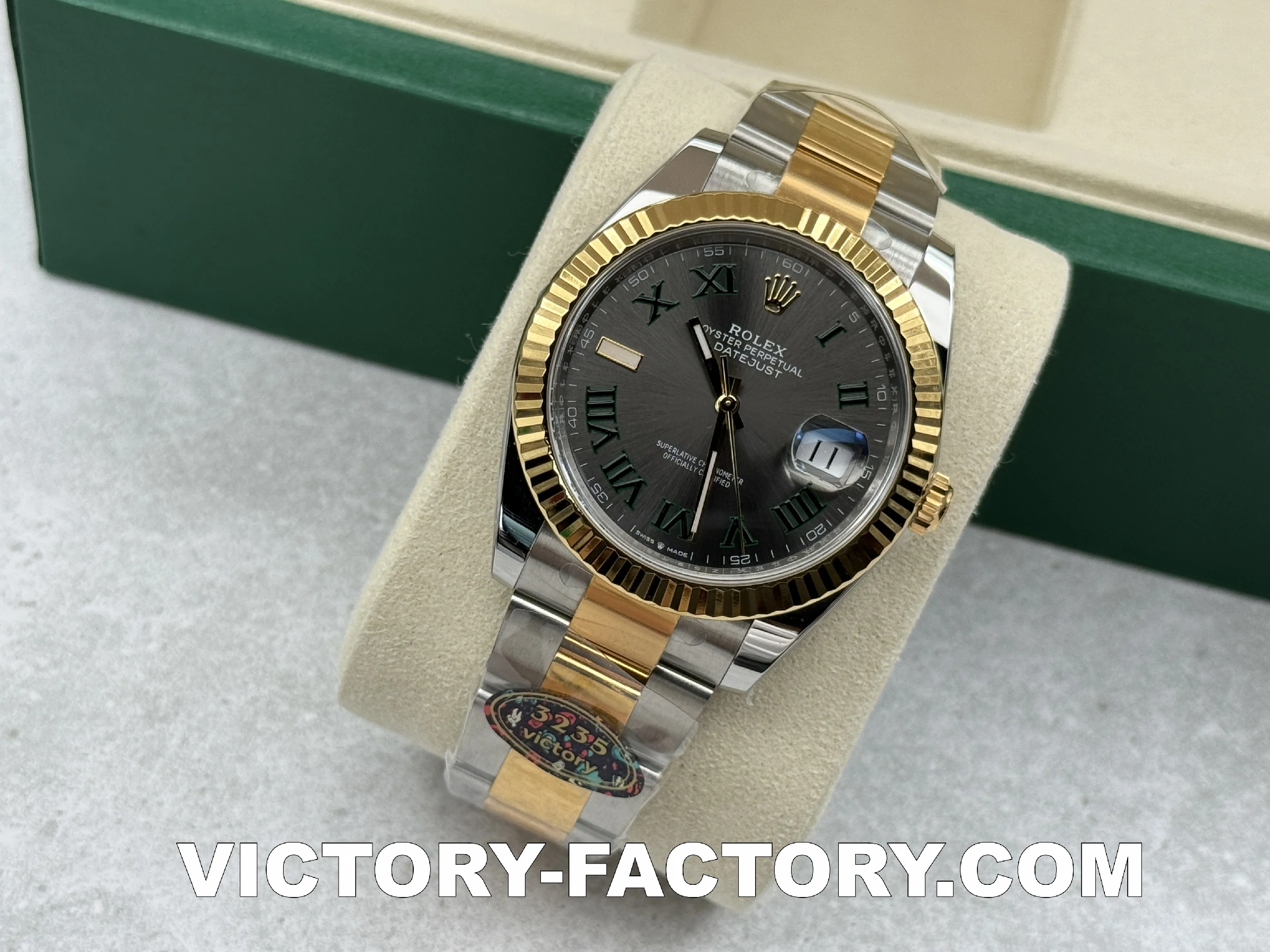
Victory Factory new 41mm yellow gold Rolex Datejust Wimbledon Dial launches with three dials and one central challenge: how do you make a two-tone bracelet that feels right at the edges? The answer took longer than expected. The result is worth understanding.
There is a familiar rhythm to how serious watch factories release new references. A case gets confirmed. A movement gets spec’d. Dials get chosen. Then, somewhere in the process, a component turns out to be harder than anticipated — and a factory either ships it anyway, or it waits until the problem is solved. Victory Factory waited.
The VF Datejust 126333 in 41mm yellow gold two-tone arrives later than originally planned, and the reason is specific: the two-tone Oyster bracelet. Getting the visible case and dial right on a Datejust is demanding but understood. Getting a gold-and-steel bracelet to the point where the side walls show no steel bleed-through, where the plating base is flat enough to feel as continuous as solid metal, where the finish at the chamfered edges holds — that is where the time went. Built on the 904L stainless steel and production knowledge that Victory Factory carries forward from its Clean Factory origins, this 126333 is the team’s first statement in yellow gold, and the bracelet is the proof of that ambition.
Three Dials, One Case
The Victory Factory Rolex Datejust Wimbledon Dial launches in three yellow gold two-tone configurations. Each shares the same 41mm case, the same fluted yellow gold bezel, the same Dandong 3235 movement, and the same bracelet. What changes is the dial — and the character that dial establishes for the watch as a whole.
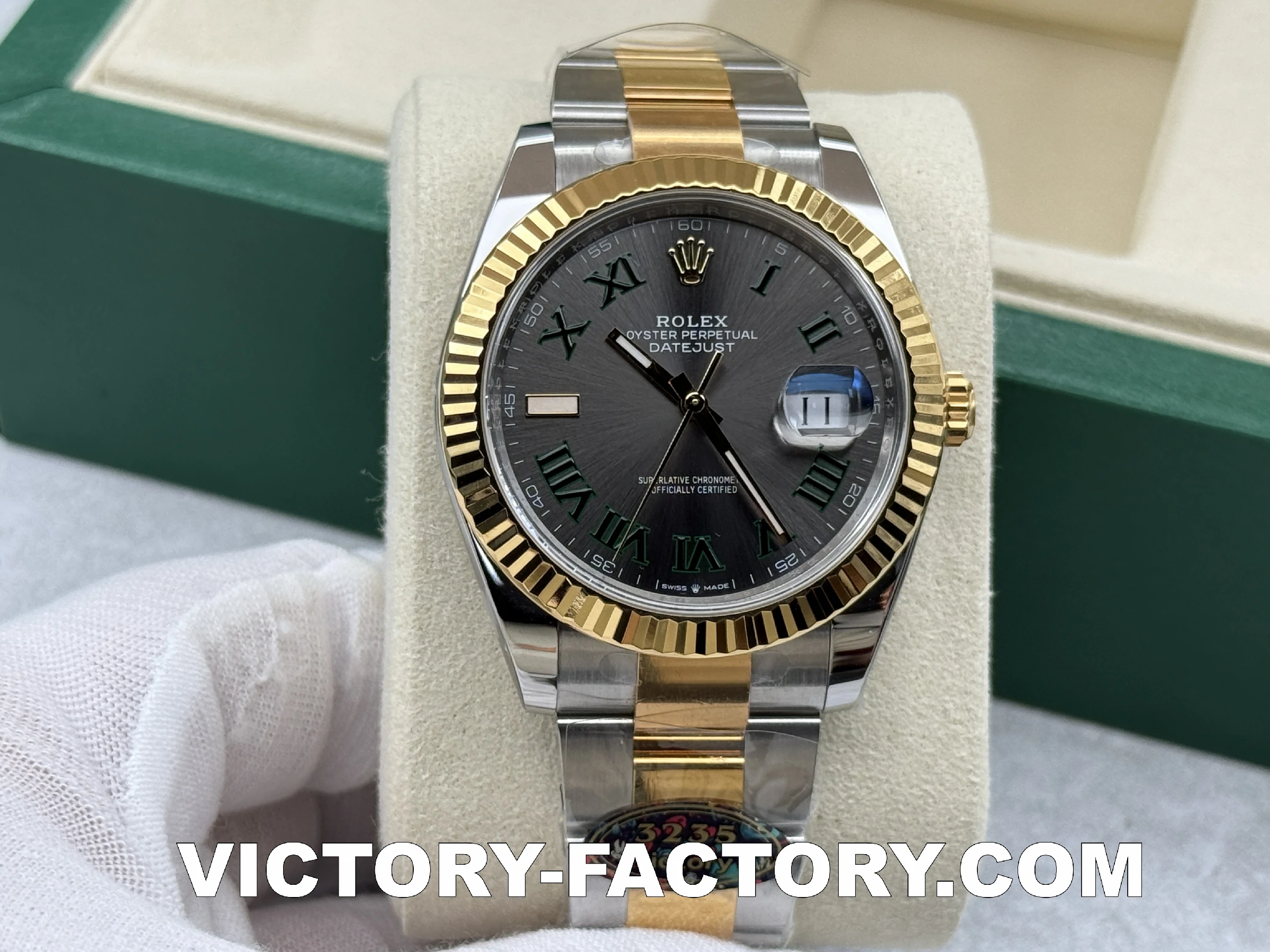
Champagne
The intuitive pairing: warm gold against warm gold, a combination that has existed in Rolex’s yellow gold Datejust lineup for decades. It reads as a cohesive whole because the tones are drawn from the same family. The sunburst finishing on the dial and the yellow gold of the case and bezel reinforce rather than contrast each other. It is the conservative choice in the best sense — the one that remains legible as a dress watch across the widest range of contexts and time periods.
Grid Champagne
The same dial taken one step further. The texture introduces visual complexity that rewards close inspection — at arm’s length it reads as champagne; at wearing distance, the grid becomes apparent, adding dimensionality to a surface that might otherwise read flat under certain light. It suits buyers who want the champagne warmth but with more to look at when they glance down.
Green (Lvy)
The contemporary choice, and the one most likely to generate a strong response in either direction. Deep green against yellow gold is a combination that Rolex has deployed across its higher-complication pieces, and that has migrated into the Datejust lineup as collector appetite for coloured dials has grown. Against the yellow gold fluted bezel, the green reads warmer than it would against white gold or steel — less austere, more connected to the gold family it sits inside.
“Three dials. The same bracelet, the same case, the same movement underneath. What changes is the conversation the watch starts when someone sees it on your wrist.”
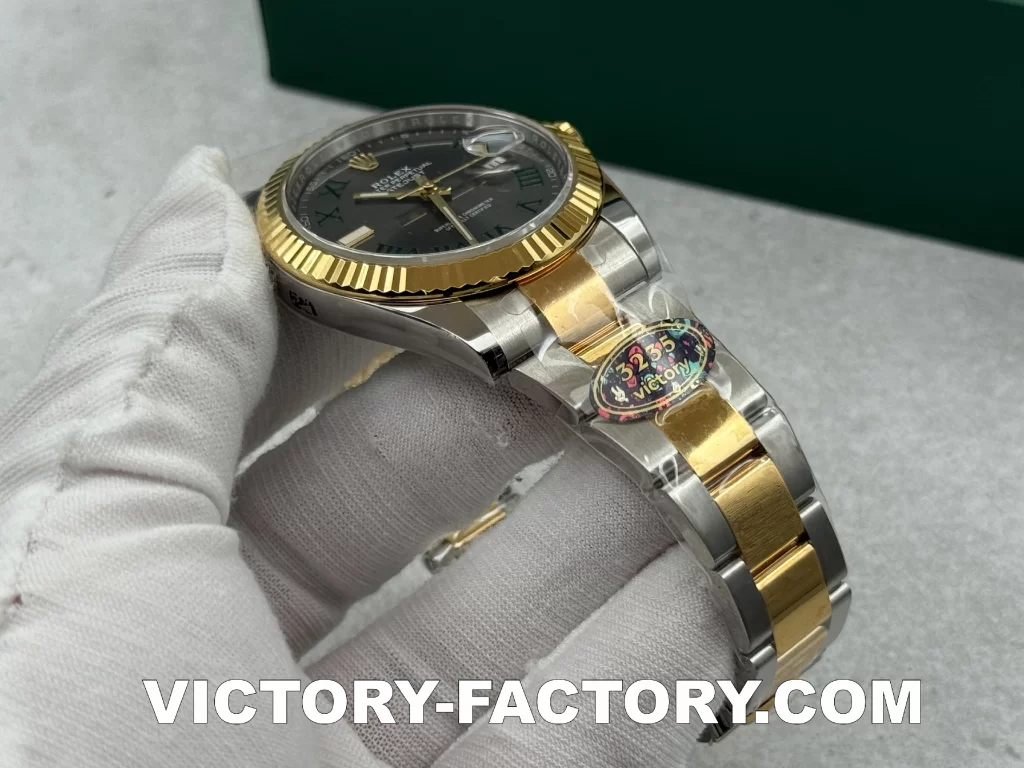
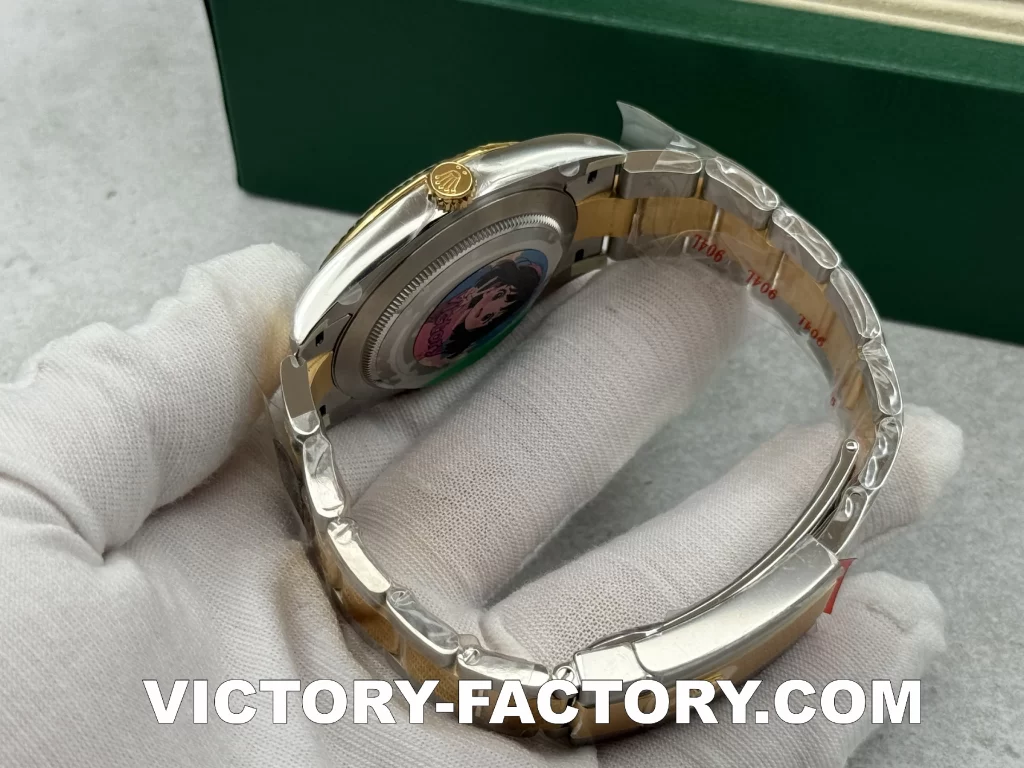
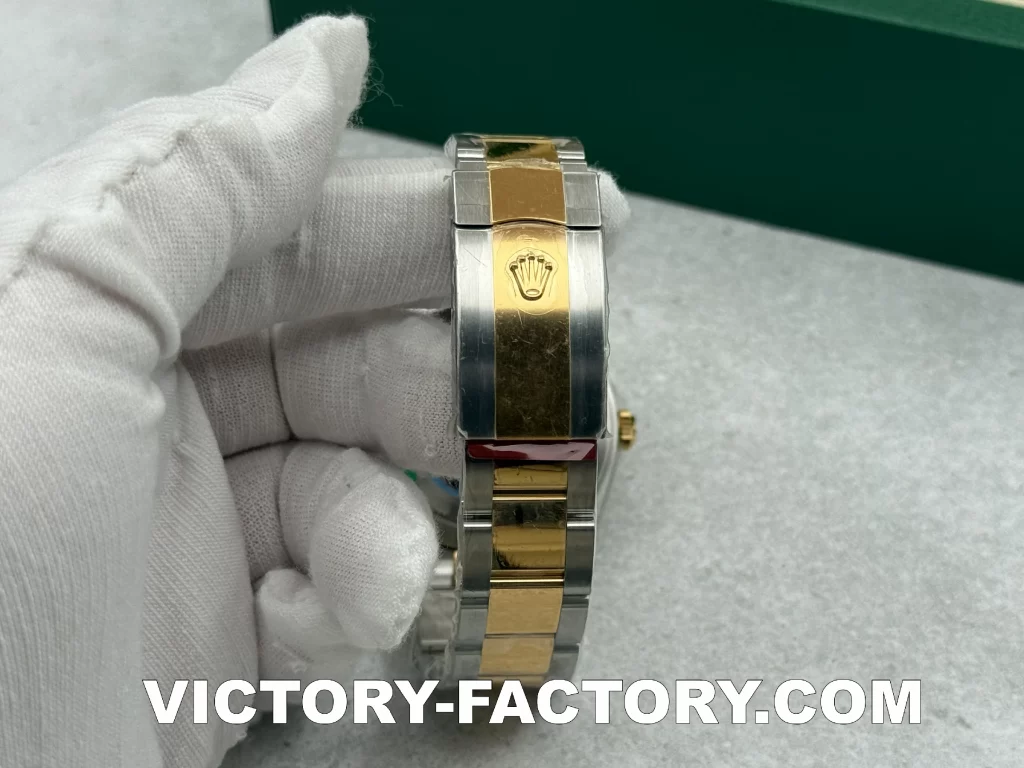
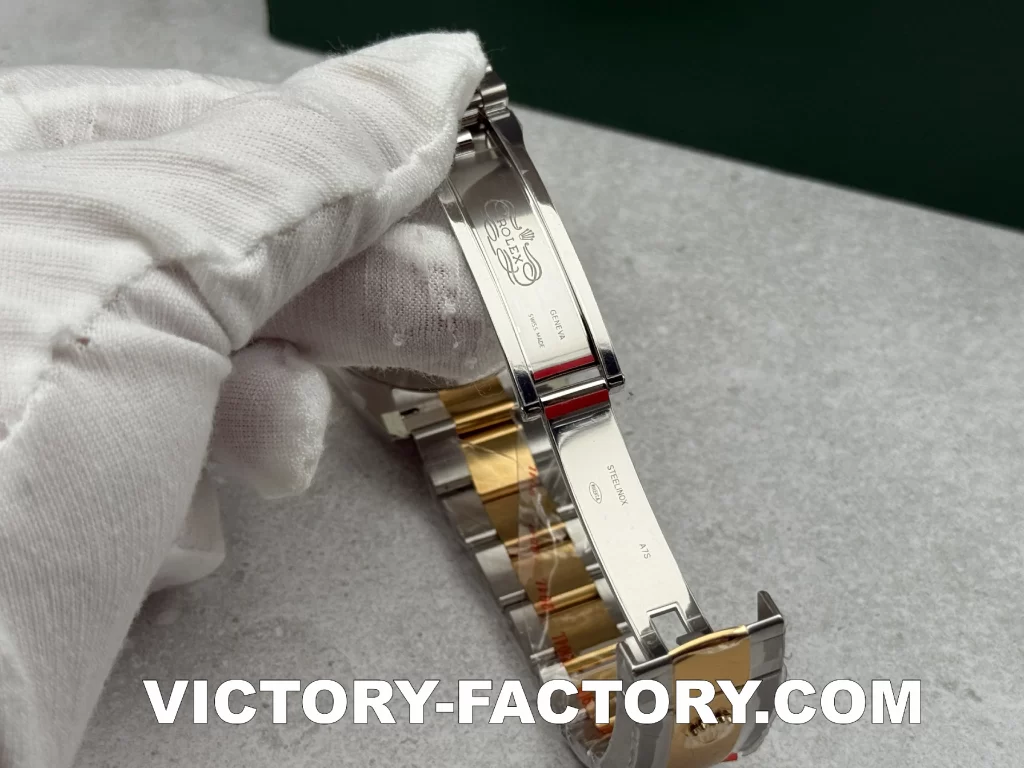
The Bracelet Problem — and How VF Solved It
Two-tone watch bracelets are among the most technically demanding components in this category, and the challenge is not widely understood by buyers who have not tried to produce one. The problem is not the gold itself — it is the interface between the gold and the steel, specifically at the edges and base of each link.
Challenge 01: The side wall problem
On a two-tone bracelet, the gold-coloured surface of each centre link must meet the steel of the adjacent outer links at a clean edge. When the plating process is imprecise, steel bleeds through at the sides — a grey shadow at the edge of what should be a continuous gold surface. This is the most visible failure mode, and the one most buyers notice first when comparing a well-made and a poorly-made two-tone bracelet side by side. The VF 126333 bracelet was refined specifically to eliminate this bleed-through, so the gold surface on each centre link terminates cleanly at the edge.
Challenge 02: The base flatness problem
The underside of each bracelet link — the surface that contacts the wrist — must be flat for the bracelet to sit correctly and feel like a continuous surface rather than a series of individual objects. When the plating base has inconsistencies, the inner wrist surface develops a textured, slightly uneven feel that is immediately perceptible during wear. VF’s focus on base flatness during the extended development period produced a bracelet that sits flush and feels consistent across the full wrist contact surface.
Challenge 03: Split-bead construction
Split-bead construction — where the end pieces of each link are separate components rather than moulded as part of the link body — allows the gold surface to wrap completely around the visible portions of each bead without interruption. VF uses split-bead construction on the 126333 bracelet. The specific focus of VF’s extended development work was on what happens at the base: the gold surface coverage and the evenness of the finish at the point where the bead meets the link body.
The practical result is a bracelet that does not announce itself as a two-tone component — it reads as a unified object. The visual transition between gold centre links and steel outer links is clean, the edges are defined, and the inner surface sits flush against the wrist.
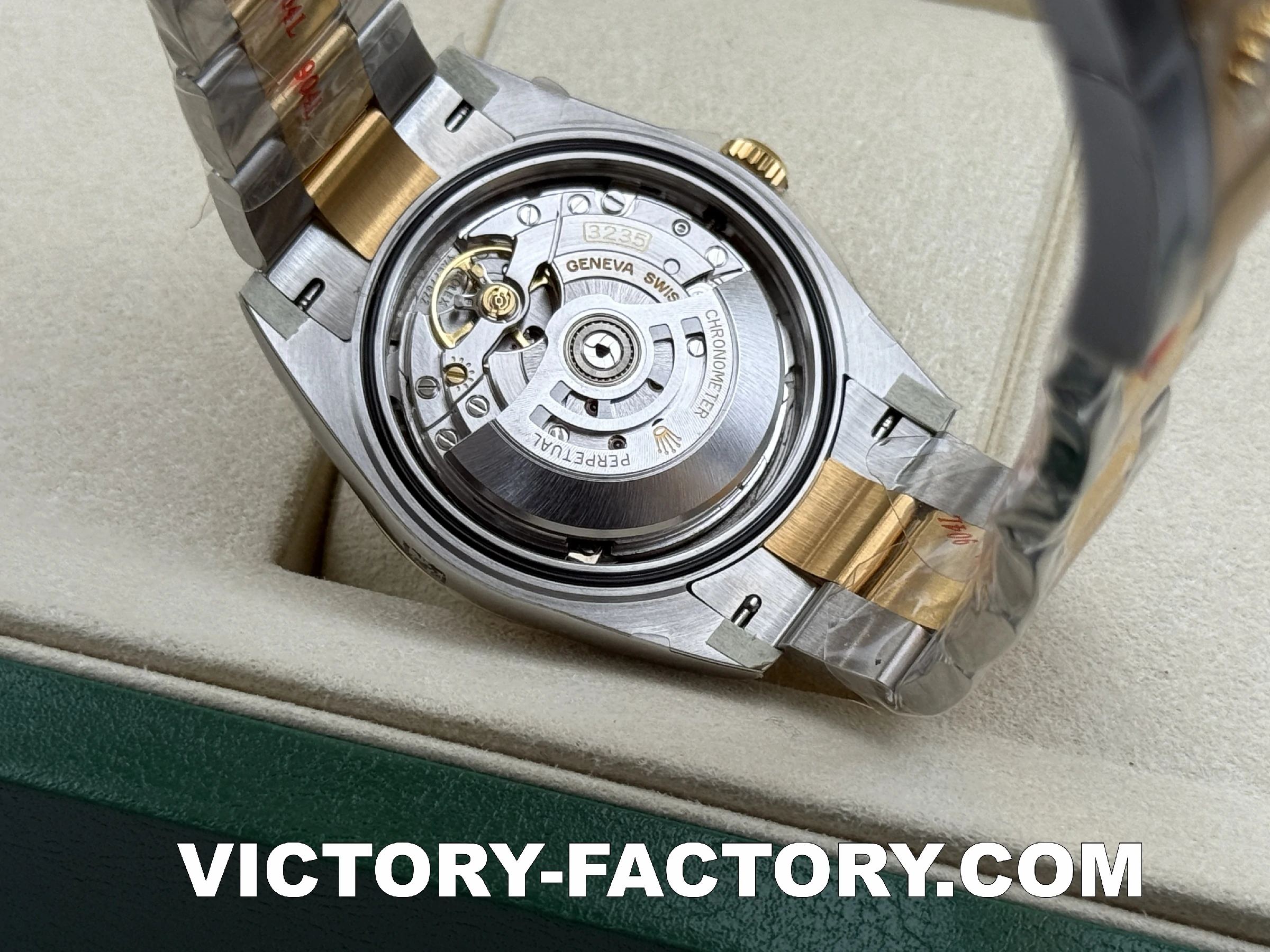
The Movement: Dandong 3235, Fully Tooled
The VF 126333 carries the Dandong Cal. 3235 — described by VF as a complete 1:1 open-mould interpretation rather than an adaptation of a prior calibre. A movement engineered from the ground up to match the genuine 3235’s architecture behaves differently from one that has been modified from an existing design. The escapement geometry, the rotor weight and travel, the feel of the seconds hand at 28,800 vph — these reflect genuine movement development.
| Specification | Detail |
|---|---|
| Movement | Dandong Cal. 3235, complete 1:1 open-mould |
| Beat rate | 28,800 vph — 4Hz smooth sweep |
| Power reserve | ~70 hours — matches genuine 3235 specification |
| Daily accuracy | -4/+6 seconds — COSC certification range |
| Case material | 904L stainless steel with yellow gold wrapping |
| Water resistance | 100 metres, screw-down crown |
The 70-hour power reserve carries the same practical significance here as across the Datejust range: a dress watch worn intermittently needs to survive the gaps between wearings without stopping. The Datejust 41 in yellow gold is a watch you reach for when the occasion calls for it. A 70-hour movement means the watch is still showing the correct time when you pick it up on Thursday after wearing it on Monday.
Yellow Gold in the Datejust Context
The Datejust was a yellow gold watch before it was anything else. When Rolex introduced the reference in 1945 to mark its 40th anniversary, it launched as a gold dress watch. The introduction of the two-tone Rolesor configuration in the following decades made the Datejust available to buyers who wanted the gold association without the full gold commitment. That two-tone identity — gold bezel and centre links, steel case and outer bracelet — is now as much part of the Datejust’s DNA as the cyclops lens over the date.
The VF 126333 enters that lineage as the factory’s first statement in yellow gold. Launching three dial variants simultaneously reflects confidence in the platform and recognition that the yellow gold Datejust buyer is not a single type: the champagne collector, the textured-dial collector, and the coloured-dial collector are different buyers, and the 126333 addresses all three at once.
Honest Notes on This Reference
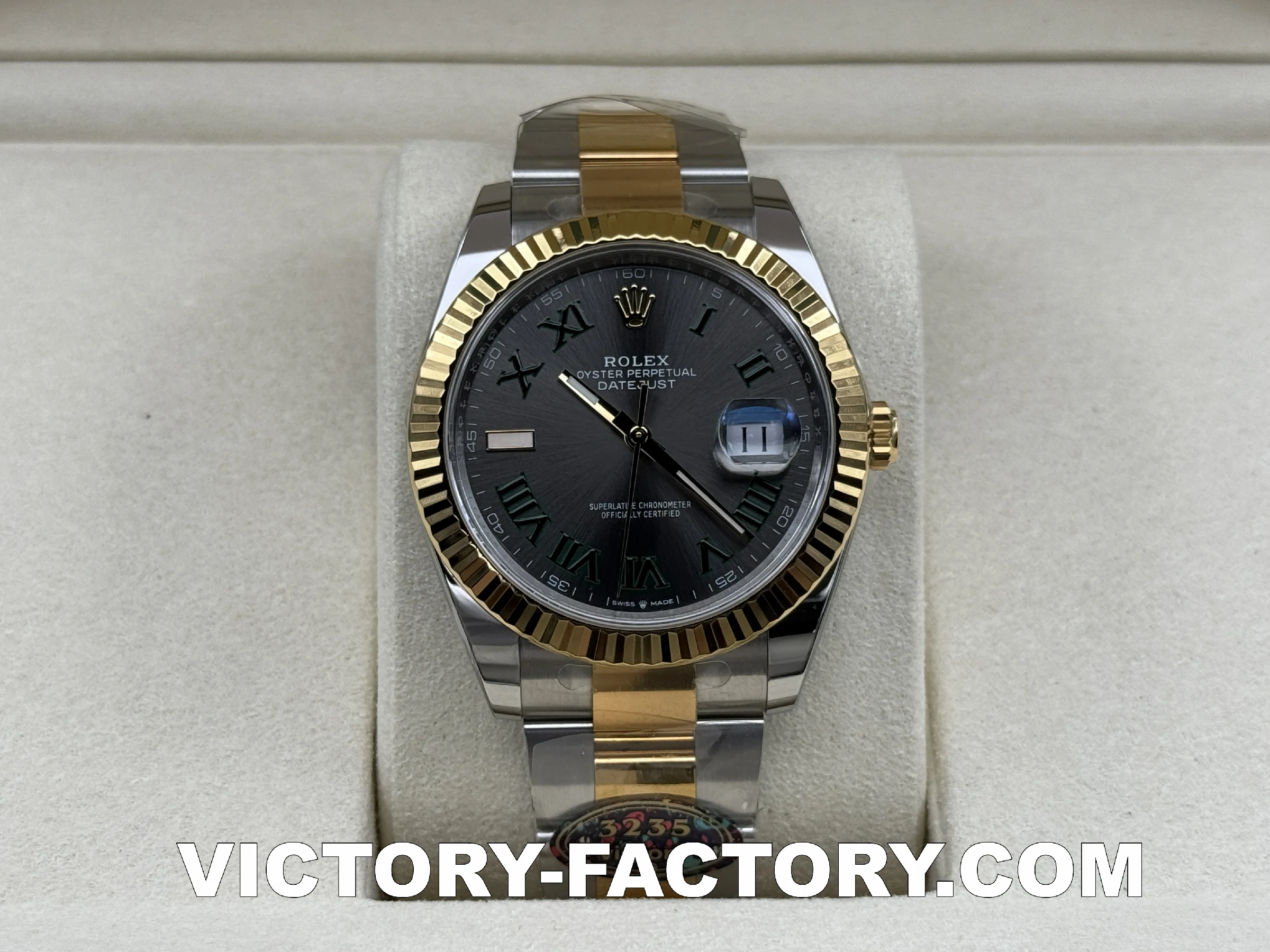
A few things worth stating plainly.
The yellow gold on the Victory Factory Rolex Datejust Wimbledon Dial 126333 — case, bezel, bracelet centre links — is yellow gold wrapping over 904L stainless steel, not solid yellow gold. The genuine Rolex 126333 uses solid 18k yellow gold on these components. This is a material difference that should be understood before purchase. The visual result at wearing distance is consistent with the genuine appearance, but the material construction is different.
The three-dial launch is a genuine simultaneous release — all three variants are available from the initial production run, and there is no hierarchy between them in build quality or component sourcing. The bracelet development that delayed this reference applies equally across all three dial configurations.
Among rolex clone references in the Datejust category, the 126333 yellow gold is the more technically demanding build, specifically because of the bracelet. The extended development period reflects that difficulty honestly. Good things, as the factory put it, do not need to be rushed.
FAQ
Q1: Why did the VF 126333 yellow gold take longer to release than other Datejust variants?
The delay was directly caused by the two-tone bracelet. Producing a yellow gold and steel Oyster bracelet where the side walls show no steel bleed-through, the inner surface sits perfectly flat on the wrist, and the finish holds at the chamfered edges is significantly harder than producing a single-material bracelet. VF chose to continue refining the bracelet rather than release a version that didn’t meet the standard they were working toward. The extra development time went entirely into the bracelet, not the case or movement.
Q2: Can I switch between the three dial versions, or is each configuration a separate watch?
Each dial configuration — champagne, grid champagne, and green — is produced as a complete watch. They are not interchangeable dial variants of the same base watch in the sense that you can swap dials yourself. If you want a different dial, you are choosing a different reference. All three share the same case, bracelet, and movement, so the choice is purely about which dial character suits you.
Q3: How does the yellow gold two-tone 126333 wear differently from the rose gold version?
Yellow gold and rose gold read differently against the steel of the case and outer bracelet links. Yellow gold creates a warmer, more high-contrast pairing with steel — the colour difference between the gold and steel elements is more pronounced, which makes the two-tone construction more visually explicit. Rose gold, being closer to the warm-neutral range, creates a softer transition. On the wrist, the yellow gold version announces itself more clearly as a two-tone piece; the rose gold version reads more subtly. Neither is more correct — it is a character choice.
Q4: Is the green dial the same shade of green as the Wimbledon dial on the 126331?
No. The green on the 126333 yellow gold — referred to as the Lvy configuration — is a different expression of green from the Wimbledon slate-grey-and-green combination. The Wimbledon dial pairs a muted, forest-toned green against a grey background; the 126333 green dial sits the colour directly against the warm yellow gold of the case and bezel, which changes how the green reads — warmer, richer, less restrained. The two dials share a colour family but have distinct characters.
Q5: Does the fluted bezel on the 126333 have the same DLC protection as the rose gold 126331?
Yes. The fluted yellow gold bezel on the VF 126333 carries DLC coating beneath the gold surface at the fluting ridge edges, providing the same scratch resistance at the most vulnerable contact points as the rose gold version. The genuine Rolex fluted bezel in solid gold does not include this treatment. It is a practical addition that VF applies across its gold-bezel Datejust variants to preserve the sharp light-catching angles of the fluting over time.
 Victory Factory (VF) Rolex Explorer II 42mm 226570 White Dial – Super Clone with Clean Factory Parts & Dandong 3285 Movement
  Victory Factory (VF) Rolex Explorer II 42mm 226570 Black Dial – Super Clone with Clean Factory Parts & Dandong 3285 Movement